
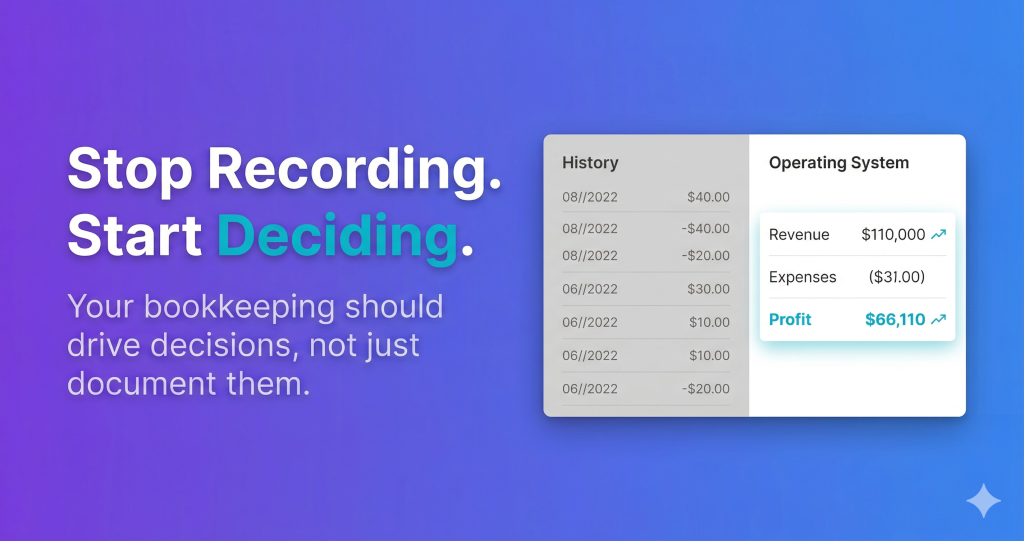
A financial operating system for small business is a structured approach to finance that translates your numbers into clear signals for action, rather than simply recording what already happened. It works by combining accurate bookkeeping with forward-looking analysis, plain-English reporting, and a consistent rhythm of decision support. The key difference is that a bookkeeper captures history while a financial operating system shapes what you do next.
Most business owners discover this distinction too late. They have clean books, a decent accountant, and still feel like they are flying blind every time a real decision lands in front of them. When your finance function is built around compliance and record-keeping alone, you get accurate history and very little clarity. When it is built around decision support, you get the same accurate history plus a clear picture of where the business is going and what it needs from you right now. This article walks through exactly how to make that shift, step by step.
Table of Contents
What a Financial Operating System Really Means
A financial operating system is not software. It is not a dashboard. It is a function inside your business that processes financial information and converts it into decisions, priorities, and actions on a consistent schedule.
It works by combining several layers that most small businesses treat as separate or optional:
- Accurate, timely bookkeeping that closes each month cleanly and completely
- Owner-ready reporting that surfaces what matters without requiring you to read a spreadsheet like an accountant
- Cash flow visibility that tells you where you stand today and where you are heading over the next 60 to 90 days
- Profit and cost driver analysis that shows which parts of the business are actually working
- Proactive flags for risks and opportunities before they become emergencies or missed windows
- A direct line to someone who can tell you what to do next, not just what happened last month
The bookkeeper records the transaction. The financial operating system asks what that transaction means for the decision you are about to make.
Why This Matters: The Cost of Running on History Alone
Here is the hard truth. Most small business owners are making six-figure decisions with three-month-old information. They look at their bank balance, make a judgment call, and move on. Sometimes that works. Often it does not, and the damage shows up quietly over time in the form of cash shortfalls, margin erosion, and a general sense that the business is harder than it should be.
When a business runs on bookkeeping alone, several predictable problems emerge:
You are always looking backward. Your books tell you what happened in March. It is now May. The gap between recorded history and current reality is where most financial mistakes live.
Numbers without context create noise, not signal. Revenue went up. Is that good? Depends on whether your costs went up faster. Depends on whether that revenue is collected or still sitting in receivables. A number without a frame of reference is just a number.
Decisions get made on instinct because the data is not decision-ready. This is not a discipline problem. This is a system problem. When your financial information requires translation before it is useful, most owners skip the translation step and go with their gut.
Tax season becomes the only financial event that matters. When your accountant is the only person reviewing your numbers, and they do it once a year, you have a compliance function, not a management function.
The common mistake is assuming this is a cash flow problem or a revenue problem. This is not a strategy problem. It is a structure problem. The information exists. It is just not organized to drive decisions.
How to Build a Financial Operating System: Step by Step
Step 1: Get Your Books Clean, Current, and Closed Monthly
This is the foundation. Nothing else works without it.
Clean books means every transaction is categorized correctly and consistently. Current means your books are never more than a few weeks behind. Closed monthly means that at the end of each month, someone reviews, reconciles, and locks the period so you have a reliable baseline.
If your books are three months behind or your categories are inconsistent, your first job is fixing that. Not because the IRS requires it, but because every insight downstream depends on the quality of this layer.
Practical actions for this step:
- Establish a firm monthly close date, ideally within 10 to 15 business days after month end
- Standardize your chart of accounts so categories reflect how your business actually operates, not just what accounting software defaults to
- Separate personal and business finances completely if you have not already done this
- Review your bank reconciliation every month without exception
Step 2: Build Owner-Ready Reporting That You Actually Read
Most financial reports are built for accountants. A profit and loss statement, a balance sheet, and a cash flow statement are complete and correct and almost entirely useless to a busy operator who has not studied accounting.
Owner-ready reporting translates those statements into a format that answers the questions you are actually asking. Questions like: Did we make money this month? Where did the money go? Are we in a better or worse position than last month? What should I be paying attention to?
To build this layer:
- Create a one-page monthly summary that highlights revenue, gross margin, net profit, and cash position in plain numbers
- Add a short written narrative, even three to five sentences, that explains what changed and why
- Track two or three metrics that are specific to your business model, not generic accounting totals
- Compare current month to prior month and to the same month last year so you have context, not just a number in isolation
The goal is a report you can read in ten minutes and walk away from knowing exactly where you stand.
Step 3: Add Cash Flow Visibility and a Forward Look
Profit and cash are not the same thing. A business can show profit on paper and run out of cash. This is one of the most common and most painful surprises in small business finance.
Cash flow visibility means you know your current cash position, your expected inflows over the next 30 to 90 days, and your expected outflows over the same period. When you have that picture, you can make decisions about hiring, spending, and investment with confidence instead of anxiety.
To build this layer:
- Track accounts receivable aging weekly so you know what is owed and when it is likely to arrive
- Map your fixed and variable expenses by month so you know your minimum cash requirement at all times
- Build a simple rolling 13-week cash flow projection, even a rough one, and update it monthly
- Identify your cash conversion cycle: how long does it take from spending money to collecting it back?
When you have a forward view on cash, you stop making reactive decisions and start making intentional ones.
Step 4: Identify Your Profit and Cost Drivers
Not all revenue is equal. Not all costs are equal. A financial operating system helps you see which parts of the business generate the most profit and which parts consume the most resources without proportional return.
This analysis does not require complex modeling. It requires honest categorization and a willingness to look at the numbers without defensiveness.
Practical steps:
- Break your revenue into segments: by product, service line, client type, or channel
- Calculate gross margin by segment, not just in aggregate
- Identify your top five cost categories and ask whether each one is growing in proportion to revenue or faster
- Look for any cost that is increasing without a corresponding increase in output or revenue
Most owners who do this exercise for the first time find at least one significant surprise. A product line that feels profitable is not. A client segment that feels difficult is actually the most valuable. The numbers tell a story that instinct often gets wrong.
Step 5: Create a Rhythm of Review and Decision Support
A financial operating system is not a one-time setup. It is a recurring rhythm. The cadence matters as much as the content.
A functional rhythm looks like this:
- Weekly: Review cash position and accounts receivable. Ten minutes.
- Monthly: Review the owner-ready report. Discuss what changed, what it means, and what decisions it informs. Thirty to sixty minutes.
- Quarterly: Review profit and cost drivers, update projections, and assess whether the business is on track against its goals.
- Annually: Full financial review with tax planning integrated into the operational picture.
The monthly review is the most important. It is where the financial operating system does its actual work. This is when you stop being a passive reader of history and start being an active manager of direction.
If you do not have someone to facilitate that conversation with you, the rhythm tends to collapse. Most owners will not hold themselves accountable to a monthly financial review without a structured prompt and a counterpart who knows the numbers.
Financial Operating System Approaches Compared
| Approach | Pros | Cons | Best For |
|---|---|---|---|
| Bookkeeper only | Low cost, keeps records clean | No analysis, no forward view | Compliance-focused, early-stage businesses |
| Bookkeeper plus annual accountant | Tax-ready, slightly more structure | Still backward-looking, no monthly insight | Businesses with simple finances and low decision frequency |
| Bookkeeper plus monthly reporting | Clean books and regular context | Reporting without interpretation can still feel unclear | Owners who can self-interpret financial data |
| Full financial operating system | Decision clarity, cash visibility, proactive flags | Higher investment, requires consistent engagement | Growth-stage businesses making frequent financial decisions |
| In-house CFO | Deep integration, full-time focus | Expensive, often over-resourced for small business | Larger businesses with complex capital structures |
Tips for Getting More From Your Financial Function
- Treat your monthly financial review as a non-negotiable meeting, not an optional task
- Ask your bookkeeper or advisor to flag anything unusual, not just report what happened
- Stop using your bank balance as your primary financial indicator
- Learn the difference between gross margin and net margin and track both
- Build your budget from your actual cost structure, not from aspirational revenue targets
- If a financial report requires explanation before you can use it, the report needs to change, not you
- Pay attention to trends over three to six months, not just the most recent month in isolation
FAQs
Q: What is the difference between a bookkeeper and a financial operating system? A: A bookkeeper records financial transactions accurately and keeps your books in order. A financial operating system uses that same data to generate forward-looking insights, cash flow visibility, and decision support. The bookkeeper captures what happened. The operating system shapes what happens next.
Q: How much does it cost to build a financial operating system for a small business? A: Costs vary depending on the scope of services. A basic version with clean bookkeeping and monthly reporting might start around $750 per month. More comprehensive support including cash flow projections, profit analysis, and CFO-level advisory will be higher. The more useful comparison is the cost of the financial decisions you are currently making without this information.
Q: Do I need accounting software to build a financial operating system? A: Accounting software is a useful tool but not the system itself. QuickBooks, Xero, and similar platforms record and organize transactions. The financial operating system is the layer of analysis, reporting, and interpretation built on top of that data. Many businesses have accounting software and still lack a functional financial operating system.
Q: How often should I be reviewing my financials? A: Cash position and accounts receivable should be reviewed weekly. A full financial review with your owner-ready report should happen monthly. Quarterly reviews are useful for trend analysis and forward planning. Annual reviews align with tax planning. The monthly review is the most important and the one most owners skip.
Q: What should my monthly financial report actually include? A: At minimum, your monthly report should show revenue, gross margin, net profit, and cash position. It should compare the current month to the prior month and to the same month last year. It should include a short plain-English narrative explaining what changed and why. And it should surface anything that requires a decision or deserves attention before next month.
Q: Can a small business afford a financial operating system? A: The more accurate question is whether a small business can afford to operate without one. Businesses making decisions without current financial information tend to overspend, underprice, miss cash shortfalls, and underinvest in what is actually working. The financial cost of those errors typically exceeds the cost of the system that would have prevented them.
Q: What is the first step if my books are a mess right now? A: Start with a clean-up. Get your books current, reconciled, and categorized correctly for at least the past three to six months. This is the foundation everything else depends on. Once your books are clean, you can build the reporting and analysis layers on top of a reliable base. Trying to build a financial operating system on disorganized books is like trying to navigate with a broken compass.
If Your Finance Function Is Just Keeping Score, It Is Time to Change the Game
Most business owners are not lacking information. They are lacking a system that turns information into clarity. The bookkeeper is doing their job. The accountant files the returns. And still, the owner sits in a meeting trying to decide whether to hire someone, take on a new client, or cut a cost, and the answer is not obvious because the financial picture is not organized around that question.
A financial operating system changes that relationship. It makes finance a function that reduces cognitive load instead of adding to it. It gives you a monthly moment of clarity instead of a quarterly moment of anxiety. It tells you what the numbers mean, not just what they are.
Building this does not require a full-time CFO or a complex technology stack. It requires clean books, owner-ready reporting, cash flow visibility, and a consistent rhythm of review with someone who knows how to connect the numbers to the decisions in front of you.
If you are ready to stop running on financial history and start running on financial clarity, www.plotpath.com is built exactly for that. It is a human-led financial operating system that gives growing businesses the bookkeeping, reporting, cash flow visibility, and CFO-level perspective they need to make better decisions every month, starting at $750 per month.


