
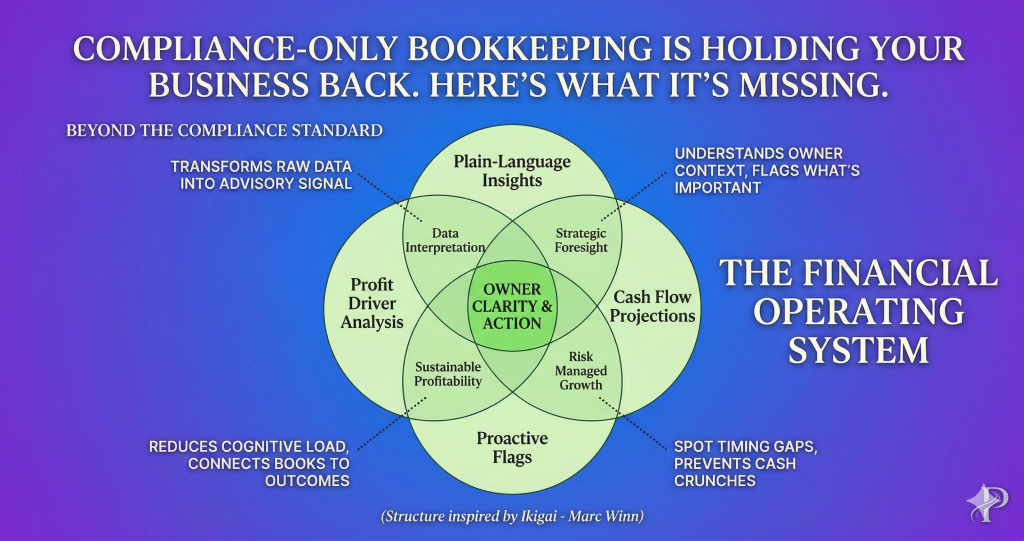
Bookkeeping is the foundation of every well-run business. Without accurate books, nothing else works. But there is a version of bookkeeping that stops at compliance, categorizing transactions, reconciling accounts, producing statements for tax time, and calling it done. That version is common, and it leaves a massive gap between what the numbers could tell you and what they actually do. Most small business owners have books that are accurate enough to file taxes but never structured to inform decisions. This post explains what compliance-only bookkeeping is missing, why that gap costs owners clarity and confidence, and what it looks like when bookkeeping is built to actually run the business.
Table of Contents
The Current State of Finance in Most Small Businesses
Here is what the typical setup looks like. A business owner hires a bookkeeper, or subscribes to accounting software, and considers the finance function covered. Transactions get categorized. A profit and loss statement gets produced once a month, sometimes once a quarter. Tax time arrives and the accountant files the return. The owner looks at the bank balance to decide whether to hire, spend, or hold.
The bookkeeping itself is fine. The books are accurate. The compliance boxes are checked. But if that is where the finance function stops, there is a whole layer of value sitting untouched.
Questions like: Can I afford to hire this person right now? If I take this contract, will I have enough cash in 60 days? Which part of my business is actually profitable and which part is quietly bleeding? What happens to my margins if my biggest client leaves?
Compliance-only bookkeeping does not answer those questions. The data to answer them is already in the books. It just never gets translated into something the owner can act on.
Most owners think their numbers are working for them. The harder truth is that their numbers are just sitting there, accurate but unused.
Why Compliance-Only Falls Short
The compliance-only model treats finance as a back-office function. Something that runs behind the business, not alongside it. The assumption is that once the books are accurate and the taxes are filed, the job is done.
That assumption works when businesses are small and simple. When a single owner can hold the whole picture in their head and a quarterly glance at the books is enough to stay oriented.
It breaks down under complexity. And complexity arrives faster than most owners expect.
When a business adds a second revenue stream, hires beyond a handful of people, takes on a large client, or starts carrying real inventory, the mental model the owner has been running on stops being reliable. The numbers become too layered to read intuitively. Cash flow and profitability diverge. Timing gaps appear between when money is earned and when it arrives.
At that point, looking at a bank balance or a raw profit and loss statement is like trying to navigate a city with a photograph instead of a map. The photograph is accurate. It just does not tell you where to go.
The compliance-only model falls short because it mistakes accuracy for usefulness. Accurate books are essential, but they are a starting point, not a finish line. When nobody translates those books into decisions, the owner carries that burden alone.
A Better Framework
Principle 1: Finance should produce signals, not just records.
A financial operating system takes the accurate books your bookkeeper produces and adds a layer of analysis and interpretation that answers a specific question: what does this mean for the decision in front of me?
The key difference is orientation. Compliance-only bookkeeping is oriented toward the past. A financial operating system is oriented toward the next decision. The books are the same. What gets built on top of them is what changes.
When a business has this layer in place, the owner does not have to figure out what the numbers mean. The numbers arrive already interpreted, with flags for what needs attention and context for what is running well.
Principle 2: Cash flow visibility is not optional past a certain size.
Most businesses that run into serious trouble do not run out of profit. They run out of cash. These are different problems with different solutions, and a business that only tracks profit and loss is flying partially blind.
A financial operating system includes cash flow visibility as a core function, not an add-on. That means knowing not just what came in and went out last month, but what is likely to happen over the next 30, 60, and 90 days based on current contracts, obligations, and patterns.
When this visibility exists, owners can make hiring and spending decisions from a position of clarity. When it does not exist, they are guessing, and sometimes the guess is wrong at a moment when being wrong is costly.
Principle 3: The finance function should reduce cognitive load, not add to it.
Here is the hard truth about most financial reporting in the compliance-only model: it is built for accountants, not operators. A standard profit and loss statement tells you what happened in aggregate. It does not surface the one number that changed and explain why it matters. It does not flag the cost that crept up 18 percent over three months. It does not tell you that your highest-revenue client is also your lowest-margin client.
A financial operating system is designed to reduce the mental work the owner has to do. The reporting is structured around decisions, not categories. The insights are written in plain language. The flags are proactive, not reactive.
The result is not just better information. It is a measurable reduction in the stress and second-guessing that come from running a business without a clear financial picture.
What This Means in Practice
The difference between compliance-only bookkeeping and a financial operating system is not about the quality of the bookkeeper. A great bookkeeper is the foundation that makes everything else possible. The distinction is about what gets built on top of those books.
Compliance-only bookkeeping produces accurate records. That is the job, and it is a necessary one.
A financial operating system starts with those same accurate records and adds the layer that turns them into something an owner can act on: cash flow projections, profit driver analysis, proactive flags, and plain-language insights.
For a business at the stage where the owner is making real bets, managing real payroll, navigating real cash timing, and trying to grow without losing control, accurate records alone are not enough. The business needs a system that tells the owner what those records mean.
Running without that system does not mean the business will fail. It means the owner is carrying a weight that the business should be carrying for them. Every major decision requires more mental energy than it should. Every cash tight moment arrives as a surprise rather than a signal. Every growth opportunity gets evaluated on instinct rather than clarity.
That is a solvable problem. But it requires expanding the finance function beyond compliance into something built around decisions.
Finance Function Comparison
| Approach | Pros | Cons | Best For |
|---|---|---|---|
| Compliance-only bookkeeping | Low cost, covers tax prep and record-keeping | No decision support, no forward visibility | Businesses under $500K with simple operations |
| Bookkeeping plus periodic CPA review | Adds tax planning layer | Still backward-looking, infrequent | Businesses needing tax guidance but not cash clarity |
| Bookkeeping plus monthly reporting package | More visibility into trends | Reporting without interpretation or advisory | Owners comfortable reading financial statements |
| Financial operating system (bookkeeping plus reporting plus advisory) | Decision clarity, proactive flags, cash visibility | Higher monthly investment | Growing businesses where decisions carry real financial weight |
| Full in-house finance team | Deepest internal knowledge | High cost, often premature for small business | Businesses with $5M or more in revenue |
FAQs
Q: What is a financial operating system for a small business? A: A financial operating system is a structured finance function that goes beyond recording transactions to deliver decision-ready insights. It works by combining accurate bookkeeping with cash flow visibility, plain-language reporting, and proactive advisory input. The key difference from standard bookkeeping is that it is oriented toward what the owner needs to decide next, not just what happened last month.
Q: Is bookkeeping not enough on its own? A: Bookkeeping is the essential foundation. Without accurate books, nothing else works. But when bookkeeping stops at compliance, it leaves a gap between the data and the decisions. Cash flow projections, profit driver analysis, and forward-looking advisory input are built on top of the books. They require the books to be right, and they turn that accuracy into something the owner can act on.
Q: At what stage does a business need more than basic bookkeeping? A: Most businesses benefit from a more structured finance function once they cross roughly $500,000 to $750,000 in annual revenue, carry a real payroll, or start making decisions that depend on cash timing. Research suggests that cash flow surprises are among the most common triggers for financial stress in growing businesses, and most of those surprises are preventable with better forward visibility.
Q: How is a financial operating system different from hiring a CFO? A: A full-time CFO is typically a $150,000 or more annual hire and is often premature for businesses under $5 million in revenue. A financial operating system delivers CFO-level thinking, including cash flow modeling, profit analysis, and decision support, at a fraction of that cost. It is designed specifically for the stage where the owner needs more than bookkeeping but does not yet need a full finance department.
Q: What does owner-ready financial reporting actually mean? A: Owner-ready reporting is structured around the decisions an owner actually faces, not around accounting categories. It surfaces the numbers that changed, explains why they matter, and flags risks or opportunities in plain language. The goal is that an owner can read the report in under 15 minutes and know exactly where to focus attention.
Q: Why do so many small businesses stick with compliance-only bookkeeping for too long? A: Most owners do not realize the gap until they are already in a painful moment, a cash crunch, a missed opportunity, a hiring decision made on incomplete information. The cost of basic bookkeeping is visible and the cost of missing decision clarity is invisible until it is not. That asymmetry keeps many businesses from expanding their finance function when they would benefit most from it.
Q: Is a financial operating system only useful for businesses that are struggling? A: No. A financial operating system is most valuable for businesses that are growing or making active decisions, not just businesses in trouble. When a business is expanding, the decisions carry more weight and the consequences of poor financial visibility are larger. Clarity is a competitive advantage in normal operating conditions, not just a rescue tool in difficult ones.
The Finance Function Your Business Actually Needs
Most owners are not bad at business. They are running a business where the finance function was set up for compliance and never expanded to support decisions. The records are accurate. The taxes get filed. And every major decision still gets made on instinct because the numbers were never translated into anything actionable.
That gap is not a personal failure. It is a structural one, and it is fixable.
A financial operating system starts with solid bookkeeping and builds the layer above it that turns accurate data into clear signals, cash visibility, and the kind of calm confidence that comes from actually knowing where your business stands.
If you are at the stage where the decisions are real and the stakes are real, the finance function should be working as hard as you are.
PlotPath is built for exactly that. It combines trusted bookkeeping, monthly owner-ready reporting, cash flow visibility, profit and cost driver analysis, and direct access to a CFO-level advisor focused on what to do next, starting at $750 per month. If you are ready to stop guessing and start deciding from a clear picture, www.plotpath.com is where to start.


