
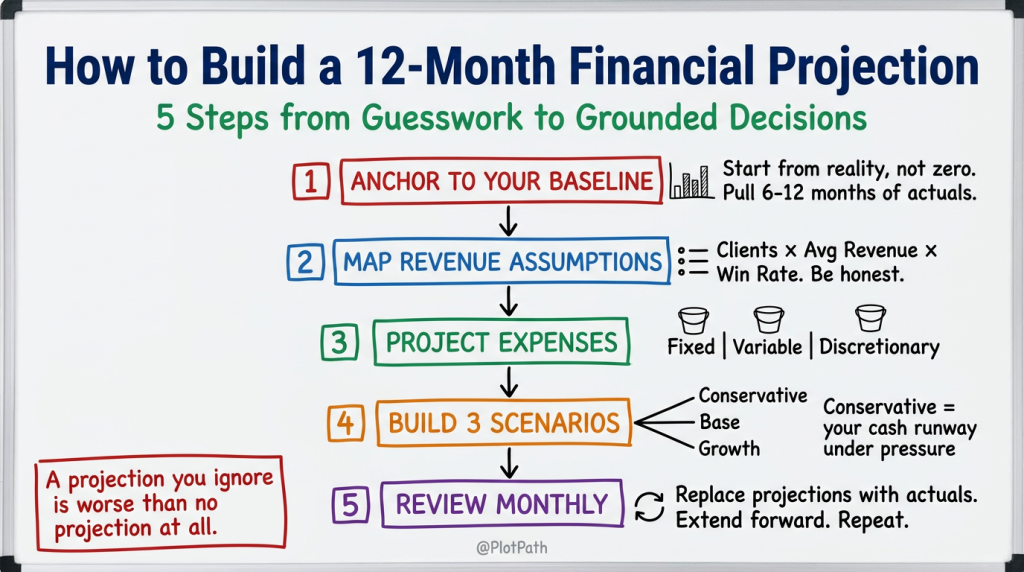
A 12-month financial projection is a forward-looking model that maps expected revenue, expenses, and cash flow across the next year. It is not a prediction. It is a structured way to pressure-test decisions before you make them.
Most service business owners skip this entirely or build one for a bank loan and never look at it again. The result is the same: decisions about hiring, spending, and growth get made on gut instinct instead of grounded assumptions. When a projection is built correctly and reviewed regularly, it becomes the clearest signal you have for what is coming and what to do about it. This guide walks through how to build one from scratch, step by step, using a 12-month financial projection template approach designed for real operators.
Table of Contents
What a 12-Month Financial Projection Really Means
A 12-month financial projection is a forward-facing financial model that estimates revenue, cost of delivery, operating expenses, and resulting cash position over the next twelve months.
It is not a budget. It is not a P&L. It is not a wish list.
- It translates assumptions into numbers so you can see what your decisions actually cost
- It reveals cash gaps, profit compression, and capacity constraints before they become crises
- It adapts monthly as actuals replace estimates, making it a living tool rather than a static document
- It separates what you know from what you are guessing, which is where the real value lives
- It gives you a reason to say no (or yes) to opportunities with something more than instinct
Why This Matters
Most owners operate in a six-week window. They know what happened last month. They have a rough sense of what is coming next month. Beyond that, it is fog.
This is how businesses get surprised by cash crunches, over-hire into soft quarters, or sit on capital they should be deploying. The problem is not intelligence or effort. The problem is visibility.
Here is the hard truth: if you cannot see twelve months ahead with even rough clarity, you are reacting to your business instead of running it.
Common mistakes that make projections useless:
- Building one for a loan application, then filing it away
- Using last year’s numbers without questioning whether the conditions still apply
- Projecting revenue optimistically while projecting expenses conservatively (the “everything goes right” model)
- Treating the projection as a target instead of a tool for scenario testing
- Never comparing projections to actuals, which means you never learn where your assumptions break
How to Build a 12-Month Financial Projection: Step-by-Step
Step 1: Anchor to Your Baseline
Start with what actually happened. Pull the last 6 to 12 months of actual revenue, cost of goods sold (or cost of delivery for service businesses), and operating expenses. Break them into categories that match how your business actually works.
Do not start from zero. Start from reality.
Look for patterns: seasonality, client concentration, recurring versus project-based revenue, and expense timing. These patterns become the foundation of your assumptions. If your revenue swings 20% between Q1 and Q3, your projection needs to reflect that, not smooth it out.
Step 2: Map Your Revenue Assumptions
Revenue is where most projections go wrong. Owners project what they want, not what the data supports.
Break revenue into its drivers:
- Number of active clients or contracts
- Average revenue per client
- New client acquisition rate (be honest here)
- Churn or contract expiration
- Upsell or expansion within existing accounts
For each driver, set a base case assumption. Then ask: what would need to be true for this number to hold? If the answer requires conditions you do not control, flag it. That is a risk, not a plan.
Step 3: Project Expenses by Category
Split expenses into three buckets:
Fixed costs (rent, salaries, insurance, software subscriptions) that stay roughly the same regardless of revenue.
Variable costs (contractor labor, materials, commissions, delivery costs) that move with volume.
Discretionary costs (marketing, training, equipment upgrades) that you can accelerate or pull back depending on conditions.
For each category, project monthly totals. For variable costs, tie them to your revenue assumptions so they scale together. Most owners underestimate how fast variable costs climb when revenue grows.
Step 4: Build Three Scenarios
A single projection is a guess. Three projections are a framework.
Build a base case (your most realistic set of assumptions), a conservative case (what happens if revenue comes in 15 to 20% below plan), and a growth case (what happens if you land that big contract or expand faster than expected).
The conservative case is the one that matters most. It answers the question every owner should be asking: how long can I sustain this if things slow down? That number, your cash runway under pressure, is the most important output of the entire exercise.
Step 5: Set a Monthly Review Rhythm
A projection that sits in a spreadsheet is decoration. A projection that gets compared to actuals every month is a decision-making system.
Each month, update the model:
- Replace projected numbers with actuals for the month that just closed
- Extend the projection forward by one month so you always have twelve months of visibility
- Note where actuals deviated from projections and ask why
- Adjust future assumptions based on what you learned
This is where the real value compounds. Over time, your assumptions get sharper. Your sense of what drives revenue and cost becomes grounded in evidence instead of optimism.
12-Month Financial Projection Template: Common Approaches Compared
| Approach | Pros | Cons | Best For |
|---|---|---|---|
| Spreadsheet (DIY) | Full control, no software cost | Time-intensive, error-prone, no guardrails | Owners comfortable with Excel or Sheets |
| Accounting software tools | Integrates with existing data | Often rigid, limited scenario modeling | Businesses already using QuickBooks or Xero |
| Outsourced CFO or advisor | Expert judgment, forward-looking | Higher cost, requires trust and fit | Owners ready for decision-grade guidance |
| Downloaded template | Fast to start, structured format | Generic, may not fit your business model | First-time projections or quick baselines |
Tips for Better Results
- Use trailing actuals as your starting point, not industry benchmarks or aspirational targets
- Separate recurring revenue from project-based revenue in your model because they behave differently
- Build your projection at the monthly level, not quarterly, so you can see cash timing clearly
- Include owner pay as a real line item, not whatever is left over
- Revisit your assumptions every month instead of defending them
- Flag any revenue line that depends on a single client or a single channel
- Keep the model simple enough that you will actually use it (a projection you ignore is worse than no projection at all)
FAQs
Q: How accurate does a 12-month financial projection need to be? A: Precision is not the goal. Directional clarity is. A projection that is 80% accurate and reviewed monthly is far more useful than one that is 95% accurate and never updated. The value comes from surfacing assumptions and adjusting them, not from hitting exact numbers.
Q: What is the difference between a financial projection and a budget? A: A budget is a spending plan. A projection is a forward-looking model of what is likely to happen based on current assumptions. Budgets tend to be static. Projections are designed to evolve as conditions change.
Q: How often should I update my 12-month financial projection? A: Monthly. Replace the prior month’s projections with actuals, extend the projection forward one month, and revisit any assumptions that drifted. This keeps the model alive and useful.
Q: Can I build a useful projection in a spreadsheet? A: Yes. Most service businesses do not need specialized software. A well-structured spreadsheet with clear assumptions, monthly columns, and a summary dashboard will work. The tool matters less than the discipline of using it.
Q: What if my revenue is unpredictable? A: That is exactly why you need a projection. Break revenue into its components (client count, average value, win rate) and project each one separately. Unpredictable revenue usually has more structure than it feels like once you decompose it.
Q: Should I include best-case and worst-case scenarios? A: Yes. Build at least three scenarios: base, conservative, and growth. The conservative case is the most important because it shows your cash runway under pressure. Knowing how long you can sustain a downturn is more valuable than knowing how much you could make if everything goes right.
Q: Do I need a CFO to build a financial projection? A: No, but having financial leadership helps. A CFO or financial advisor adds judgment to the model, challenges assumptions you might not question on your own, and connects the projection to actual decisions. The projection is the tool. The thinking behind it is what drives results.
Turn Your Numbers Into Forward Control
For business owners who want their financial data to drive decisions instead of just document history, a structured projection process provides the visibility and confidence to act with intention. PlotPath is one example of this approach, combining clean financial data with forward-looking guidance designed to help owners see what is coming and know what to do about it.


