
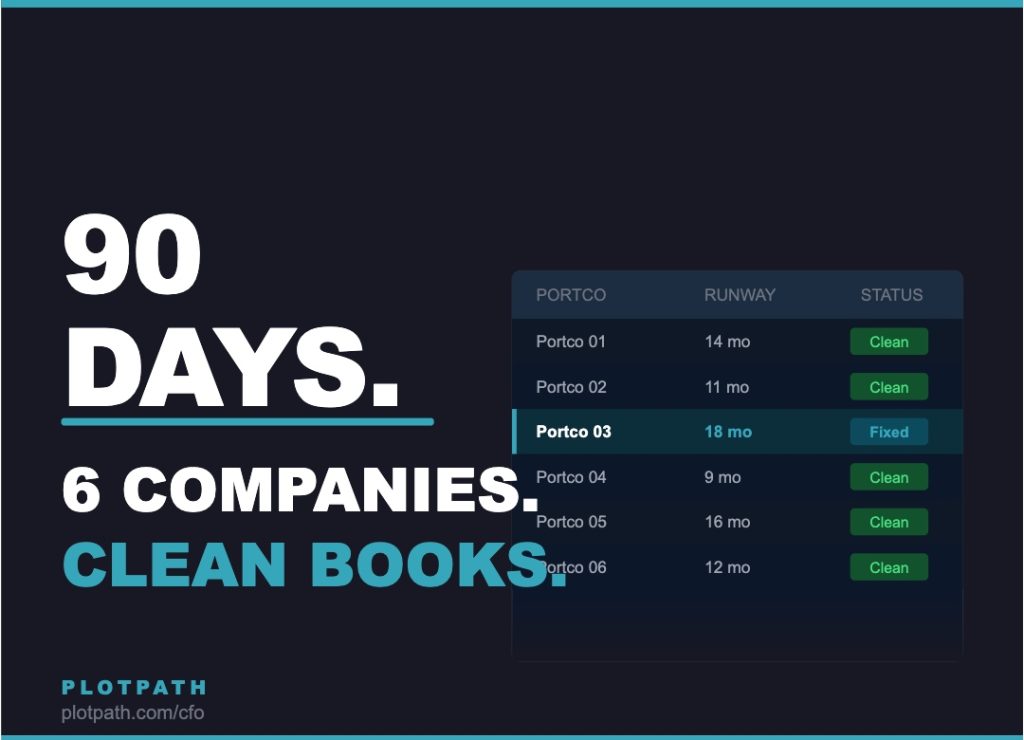
A finance partner first 90 days engagement should produce three things: reliable numbers, a reporting cadence the firm can trust, and portcos that are no longer a financial blind spot. When a Boston-based venture capital firm brought PlotPath in to serve as fractional CFO across six portfolio companies, that is exactly what the first quarter was designed to deliver. The portfolio spanned early-stage SaaS platforms, a B2B dev tools company, and two home services businesses at the growth stage. Each had a different finance setup. Most had no real finance infrastructure at all.
The firm had a problem that many GPs recognize but few name directly: they were investing in companies without knowing where those companies actually stood financially until something forced the question.
Table of Contents
The Problem
The firm managed a portfolio of six active companies ranging from pre-revenue SaaS to home services businesses doing $2M to $4M annually. On paper, each company had “someone handling the books.” In practice, that meant three founders running QuickBooks on their own, one company sharing a bookkeeper with another portco from a prior fund, and two companies that had not closed their books in over four months.
The GP responsible for portfolio operations described the situation plainly: burn rate numbers came in three different formats, on three different timelines, and none of them could be reconciled against actual bank activity without a phone call.
LP reporting was due in 11 weeks.
Four of the six companies were within 18 months of their next raise.
The firm needed a finance partner who could move across the entire portfolio without starting from scratch at each company, standardize what was being reported, and get the books to a state an investor could actually trust.
The Approach
PlotPath was engaged as fractional CFO across all six companies simultaneously, with a defined 90-day mandate: stabilize the books, establish a reporting cadence, and surface any financial risks the firm did not yet know it had.
The engagement started with a financial diagnostic at each company. Not a pitch. Not an onboarding call. A real assessment of what existed, what was missing, and what the cost of the current state was at the fund level.
What the diagnostic found across the six companies:
Three companies had unreconciled accounts going back more than 90 days. Two of the SaaS companies were recognizing revenue incorrectly, which would have created problems in due diligence. One home services company had no separation between owner draws and operating expenses, making true profitability impossible to calculate. None of the six companies had a standardized monthly close or a reporting format the GP could read without follow-up questions.
From there, the work divided into two tracks running in parallel.
Track one: Stabilization. Clean the books at each company to a state where monthly close was possible. Reconcile outstanding accounts. Correct revenue recognition at the two SaaS companies. Separate owner and operating activity at the home services company. This was not glamorous work. It was necessary work.
Track two: Infrastructure. Build a reporting standard that could run across all six companies and produce output the GP could read in one sitting. Burn rate. Runway at current spend. Gross margin by business line. Cash position against the prior month. One format. One cadence. Delivered on the same day each month across every portco.
The Results
By day 30, four of the six companies had completed their first clean monthly close in more than a quarter. The other two completed theirs by day 45.
By day 60, all six companies were on the same reporting cadence. The GP received a single portfolio-level summary each month alongside the individual company reports, giving a consolidated view of cash, burn, and runway across the portfolio for the first time.
By day 90:
- LP reporting was submitted on time with financials the firm could stand behind
- The two SaaS companies had corrected revenue recognition, removing a due diligence risk that would have surfaced during their next raise
- The home services company had clear profitability numbers for the first time, revealing that one service line was underpriced by approximately 18%
- Burn rate across the portfolio was current within five business days at all times
- The GP had not made a single phone call to chase a financial update in six weeks
The firm did not hire additional headcount. The finance infrastructure was deployed across six companies through one engagement.
What Made the Difference
Three things separated this from prior attempts the firm had made to solve the same problem.
One point of accountability across the portfolio. Every prior solution had been portco-specific. One bookkeeper here, one fractional CFO there. The result was a patchwork with no common standard and no one responsible for the portfolio view. A single finance partner operating across all six companies meant one reporting format, one close date, and one person the GP called when something needed attention.
Startup-specific financial fluency. General bookkeepers hired by early-stage companies frequently cannot handle deferred revenue, equity compensation entries, or SaaS-specific metrics. Two of the portcos had revenue recognition errors that a standard bookkeeper would not have caught because they required an understanding of how SaaS contracts are structured. That fluency is not optional when the books will eventually face investor scrutiny.
Separation of stabilization and ongoing operations. Most finance engagements try to run both at once and do neither well. The 90-day structure forced a clear sequence: clean first, then build the system that keeps things clean. The portcos did not get ongoing reporting until the foundation was solid enough to report from.
Lessons From This Finance Partner First 90 Days Engagement
The clearest takeaway from this engagement is not about bookkeeping. It is about risk surface.
Every portco with unreliable books represents a risk the GP is carrying without knowing it. Not a theoretical risk. A real one with a specific cost: LP reporting that cannot be verified, due diligence that surfaces problems at the worst possible moment, and cash crises that arrive without warning because no one was watching the numbers closely enough.
A finance partner first 90 days engagement does not fix every problem. What it does is make the problems visible, addressable, and no longer hidden inside spreadsheets a founder built at midnight.
The firms that treat finance infrastructure as a competitive advantage, not a back office detail, are the ones whose portcos walk into raises with clean books and walk out with term sheets.
Finance Partner Approaches Compared
| Approach | Pros | Cons | Best For |
|---|---|---|---|
| Founder-managed books | Low cost, direct control | No financial expertise, high error rate | Pre-revenue, pre-seed only |
| Individual portco bookkeeper | Portco-level ownership | No portfolio visibility, inconsistent standards | Single-company oversight |
| Large accounting firm | Brand credibility | Slow, expensive, portcos are low priority | Later stage, audit-ready companies |
| Fractional CFO per portco | Startup-specific expertise | High cost, no portfolio standardization | One high-priority portco |
| Portfolio-level finance partner | Standardized reporting, one point of contact | Requires a partner who can operate across sectors | Seed through Series B portfolios |
Frequently Asked Questions About Finance Partner First 90 Days
Q: What should a finance partner actually deliver in the first 90 days? A: A finance partner first 90 days engagement should produce clean, reconciled books at every company in scope, a standardized monthly reporting cadence, and a clear view of cash, burn, and runway that does not require follow-up calls to verify. If those three things are not in place by day 90, the engagement has not delivered its core value.
Q: How does a portfolio-level finance partner differ from hiring a bookkeeper for each portco? A: A bookkeeper at each portco solves a portco-level problem. A portfolio-level finance partner solves the fund-level problem. The difference is standardization: one reporting format, one close cadence, one point of accountability across every company. A collection of individual bookkeepers cannot produce a consolidated portfolio view or surface risks that only become visible when you look across the full set of companies at once.
Q: When is the right time for a VC firm to engage a finance partner for its portfolio? A: The right time is before the problem is urgent. Most firms engage a finance partner after a portco enters due diligence with books that are not ready, or after LP reporting reveals gaps in the underlying financials. Engaging earlier, at the point of investment or shortly after, removes the risk rather than managing it after it surfaces.
Q: Can one finance partner operate effectively across companies in different sectors? A: Yes, provided the partner has experience with the accounting complexity specific to those sectors. SaaS companies require fluency in deferred revenue and ARR. Home services companies require clean separation of operating and owner activity and job-level cost tracking. A finance partner without that fluency will produce clean-looking books that still contain errors an investor will find.
Q: How does a portfolio finance partner help with LP reporting? A: LP reporting is only as reliable as the portco financials underneath it. A portfolio finance partner standardizes the close process and reporting format at each company, so the numbers feeding into LP reports are current, reconciled, and consistent. That removes the most common source of LP reporting risk: portco financials that have not been properly closed or verified before the fund-level report is assembled.
Q: What does it cost to engage a fractional CFO across a portfolio of startups? A: Cost varies based on portfolio size, the current state of the books at each company, and the level of ongoing advisory support required. The more relevant framing is cost relative to the alternative: a portco that enters due diligence with unreliable books, or a cash crisis that surfaces without warning because the numbers were not current. PlotPath engagements start at $550 per month per company and scale based on scope.
Q: What happens after the first 90 days? A: The first 90 days establish the foundation. What follows is an ongoing finance operating system: monthly close, regular reporting, cash flow visibility, and proactive flags when something in the numbers warrants attention. The goal is a portfolio where the GP always knows where every company stands, without having to ask.
If Your Portfolio Has a Finance Infrastructure Problem, This Is What Solving It Looks Like
Most VC firms know the problem exists. The portco books are inconsistent, the reporting cadence is unreliable, and the GP is carrying financial risk that nobody has fully mapped.
The firms that address it systematically, with a finance partner who operates across the portfolio rather than one company at a time, are the ones whose portcos are ready when it matters: at the raise, at the LP update, and at the board meeting where someone asks a specific question about gross margin and the answer is already in the report.
PlotPath provides fractional CFO services and bookkeeping built for portfolio-stage companies, deployed across your full portfolio with one consistent standard. If your portcos need a finance infrastructure that actually holds up, learn more at plotpath.com/cfo.


