
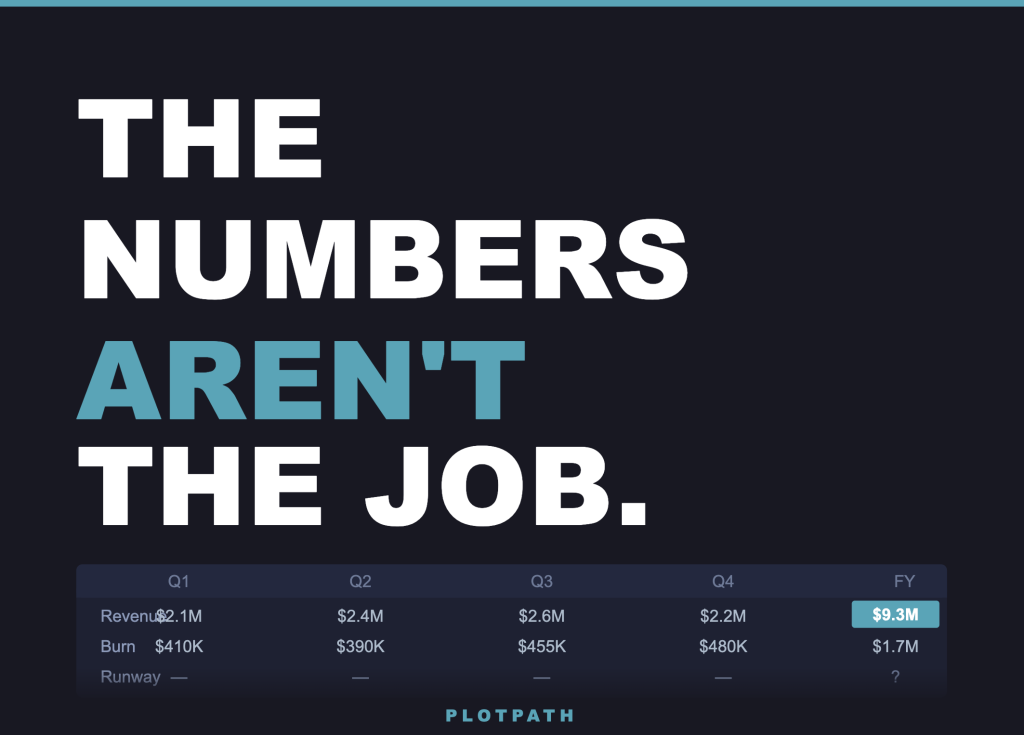
It’s to Explain What They Mean.
Most board decks arrive with accurate numbers and no useful context. The revenue line is there. The burn rate is there. The runway figure is there. And everyone in the room still walks out uncertain about what to do next.
This is not a data problem. It is a CFO role problem.
The CFO role is widely understood as financial stewardship: close the books, produce the reports, keep the numbers clean. That framing is not wrong, but it is incomplete. When a portfolio company CFO stops at reporting, they have done the equivalent of handing a map to someone who does not know where they are standing. The numbers exist. The orientation does not. What boards and investors need is not more data. They need someone who can translate the data into a clear picture of where the business is, why it got there, and what the decision set looks like from here.
This article examines why the explanation function of the CFO role is undervalued, how its absence creates risk at the board and portfolio level, and what a stronger model looks like in practice.
Table of Contents
The Current State of Board Reporting
Board reporting has a format problem and a function problem. Both are worth naming clearly.
The format problem is familiar to anyone who has sat through a board meeting at an early-stage company. The deck arrives the night before, or the morning of. It follows a template that was probably inherited from a previous investor or copied from a startup advice blog. Revenue is on slide three. Burn is on slide four. Pipeline is on slide five. The numbers are presented as facts, not as arguments.
The function problem is less often discussed. Financial reporting at most portfolio-stage companies is designed to satisfy, not to inform. The goal, consciously or not, is to demonstrate that the finance function exists and is operational. Clean numbers signal competence. What they rarely signal is direction.
Data shows that early-stage companies with strong financial communication practices raise subsequent rounds at higher rates and with shorter timelines. The quality of the numbers matters. The quality of the explanation matters more.
Why the Old Thinking Fails
The compliance model of the CFO role made sense in a different era. When the primary audience for financial reporting was a tax authority or an auditor, accuracy was the job. Get the numbers right. File on time. Keep the records clean.
The modern CFO role, particularly inside a venture-backed company, operates in a completely different context. The audience is not a regulator. It is a board, a set of investors, and increasingly a set of LPs who are evaluating whether the firm they backed has the operational visibility to protect their capital.
This matters because the decisions that boards need to make are forward-looking. Should we extend runway by cutting headcount? Is the gross margin trend a pricing problem or a delivery cost problem? Is the current burn rate sustainable given the pipeline, or does it assume conversion rates we have not hit in six months? These are not questions that a P&L answers directly. They are questions that require someone to synthesize the financial data, apply judgment, and deliver a clear point of view.
When that function is missing, two things happen. First, boards fill the gap themselves, which means every meeting becomes an analytical session rather than a decision-making session. Second, the founder, who is almost always present, absorbs the uncertainty and carries it back into the business as unresolved ambiguity.
The real problem is not that the numbers are wrong. It is that no one in the room has the mandate to explain what they mean.
A Better Framework
Reframing the CFO role around explanation rather than reporting changes three things: what gets prepared before the board meeting, how financial updates are structured during it, and what follow-through looks like after it.
Principle 1: Every financial update should answer three questions before it is presented.
The three questions are: what happened, why it happened, and what it means for the next decision. This sounds obvious. It rarely gets executed. A revenue number without a “why” is a data point. A revenue number with a “why” and a “so what” is a brief. The CFO role is to deliver briefs, not data points.
Principle 2: Board reporting should be organized around decisions, not categories.
The standard financial deck is organized by category: P&L, balance sheet, cash flow, pipeline. A decision-organized update looks different. It surfaces the one or two financial questions the board actually needs to resolve that quarter and builds the financial narrative around them. What is the cash position and what does it mean for the next six months of hiring decisions? What does the gross margin trend tell us about whether the current pricing model is sustainable? Category-organized reporting answers “what.” Decision-organized reporting answers “now what.”
Principle 3: Financial storytelling is a distinct skill from financial accuracy, and it requires deliberate development.
Financial accuracy is a threshold requirement. A CFO who cannot close the books correctly is not doing the job. But accuracy without narrative is a partial capability. Financial storytelling, the ability to take a set of numbers and construct a coherent, honest account of what they reveal about the business, is learned separately and practiced deliberately. It requires understanding the audience, knowing which details carry signal and which carry noise, and being willing to deliver an interpretation rather than a recitation.
What This Means for Portfolio Finance Infrastructure
The CFO role framing matters at the individual company level. It matters more at the portfolio level.
A VC firm with 12 portfolio companies has 12 different finance functions, each at a different maturity level. Some have full-time CFOs. Most have a bookkeeper, a founder acting as de facto financial lead, and a quarterly board meeting where the numbers get presented without much explanation. The result is a portfolio where financial visibility is inconsistent, where LP reporting depends on numbers that have not been fully synthesized, and where the firm’s GPs are frequently in the position of interpreting financial updates that were never designed to be interpreted by someone outside the building.
This is a systems problem, not a talent problem. The founders are not failing. They were never given the right model for what board reporting is supposed to accomplish.
The firms that solve this problem do not do it by hiring a CFO for every portco. They do it by establishing a standard for what financial communication should look like across the portfolio, and deploying infrastructure that enforces that standard consistently. Burn and runway numbers that arrive in the same format, on the same cadence, with the same explanatory context, regardless of which portco they come from.
That is what investor communication looks like when it is designed as a system rather than assembled company by company.
Old vs. New Approaches to Board Reporting
| Approach | Pros | Cons | Best For |
|---|---|---|---|
| Category-organized reporting | Familiar format, easy to produce | Answers “what,” rarely answers “now what” | Compliance-focused environments |
| Decision-organized reporting | Aligns the board around a specific question | Requires more preparation and judgment | Active boards making near-term decisions |
| Founder-prepared updates | Low cost, founder owns the narrative | High variance in quality and consistency | Very early stage with low board complexity |
| CFO-prepared briefs with narrative | High signal, builds investor confidence | Requires a capable finance lead | Series A and beyond, investor-active portcos |
| Standardized portfolio reporting | Consistent visibility across companies | Requires upfront infrastructure investment | VC firms managing 5 or more active portcos |
Frequently Asked Questions About the CFO Role
Q: What is the primary difference between a controller and a CFO in a portfolio-stage company? A: A controller owns the accuracy of the books, the reconciliation process, and the close. A CFO owns the interpretation of what those books mean for the business. In a well-functioning finance function, both roles exist and neither substitutes for the other. At early-stage companies, the distinction often collapses because one person is doing both, which usually means interpretation suffers.
Q: How should a startup CFO prepare for a board meeting differently than a finance manager would? A: A finance manager prepares by ensuring the numbers are accurate and formatted correctly. A startup CFO prepares by determining what the numbers reveal about the business and what decision or question the board needs to leave the meeting having resolved. The preparation difference is in the question being asked: “Is this right?” versus “What does this mean and what should the board do with it?”
Q: What does financial storytelling mean in the context of board reporting? A: Financial storytelling in board reporting is the practice of constructing a coherent, honest narrative from financial data. It means explaining not just what the numbers are but why they are that way, what they reveal about the underlying business dynamics, and what they imply for near-term decisions. It is distinct from spin or optimism. The goal is clarity, not persuasion.
Q: Why do LP reporting problems often trace back to portco-level financial communication? A: LP reporting depends on the quality of the financial data flowing up from portfolio companies. When portco CFOs or founders present numbers without adequate context or reconciliation, those gaps propagate. A GP cannot produce clean LP reporting on top of unreliable portco financials. The quality of investor communication at the portco level directly determines the quality of fund-level reporting.
Q: At what stage should a portfolio company invest in a dedicated CFO function? A: The right trigger is not revenue or headcount. It is decision complexity. When the business is making consequential decisions about hiring, pricing, capital allocation, or runway extension on a regular basis, and when those decisions depend on financial interpretation rather than just financial accuracy, the CFO function becomes necessary. For many companies, this point arrives between seed and Series A.
Q: How does the CFO role change as a company approaches a fundraising process? A: Approaching a raise, the CFO role shifts from internal clarity to external communication. The financial narrative that was being used to guide internal decisions now needs to hold up to investor scrutiny. Books need to be investor-grade: reconciled, consistent, and auditable. The explanation function becomes even more important, because investors are evaluating not just the numbers but the quality of financial thinking behind them.
Q: What is the most common board reporting failure at early-stage companies? A: The most common failure is presenting financial results without explaining the variance. Revenue came in below plan. Burn came in above. These are facts. What the board needs is the “why” behind each variance and a clear-eyed view of whether the underlying dynamic is changing or stable. Without that context, the board is left to speculate, which produces longer meetings and worse decisions.
The CFO role is not a reporting function with some strategy bolted on. It is a translation function: turning financial data into the clear, honest signals that boards and investors need to make good decisions. The accuracy of the numbers is the floor. The quality of the explanation is the ceiling.
Most early-stage finance functions are built to clear the floor. The firms that build them to reach the ceiling are the ones that walk into every board meeting with a room that is aligned, informed, and ready to decide.


