
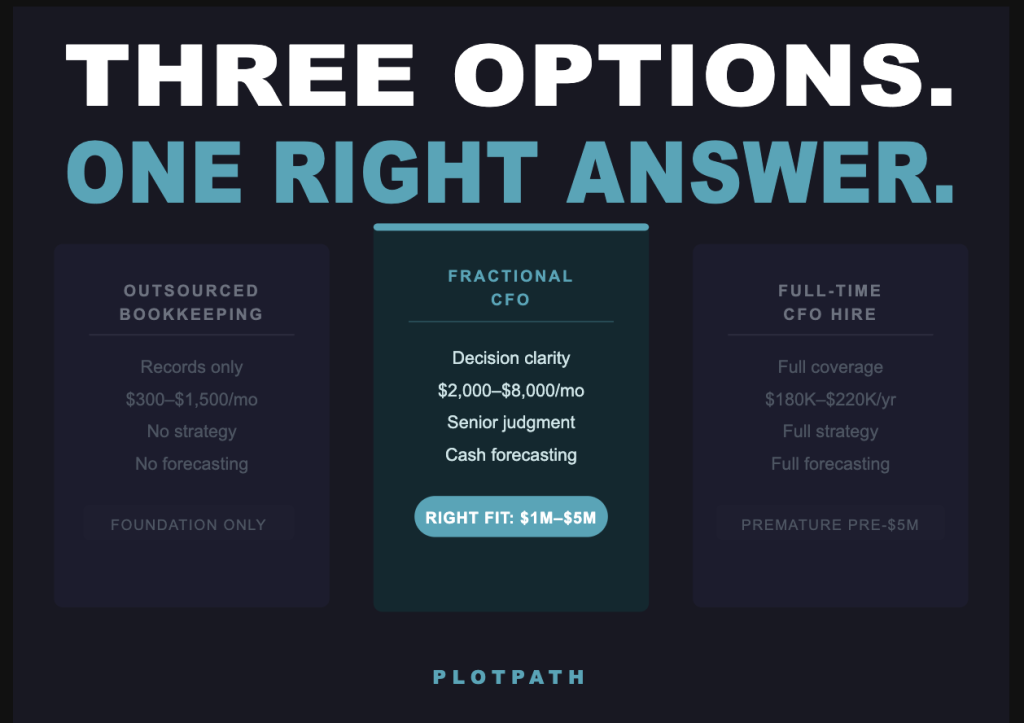
Choosing the right finance setup is one of the most consequential decisions a small business owner makes, and a fractional CFO for small businesses is not always the starting point. Each option, outsourced bookkeeping, fractional CFO, and full-time finance hire, serves a different function and operates at a different level of financial judgment.
Most owners treat this as a budget question. It is not. It is a financial maturity question. Getting it wrong does not create immediate problems. It creates invisible ones that surface later, usually at the worst possible moment.
When the right structure is in place, owners make decisions with confidence, cash is visible, and growth is measurable. When it is wrong, financial clarity stays out of reach regardless of how much the business earns.
This article breaks down what each option actually does, where each one fits, and how to choose the right structure for where your business stands today.
Table of Contents
Quick Answer
Choose outsourced bookkeeping if your records are behind, transactions are piling up, or you simply do not trust the accuracy of your books. Clean records are the foundation. Nothing else functions properly on top of unreliable data.
Choose a fractional CFO for small businesses if your books are current and you need someone to translate the numbers into decisions. Cash flow questions, profitability by service line, hiring thresholds, pricing decisions. This is the right structure for most businesses between $1M and $5M in annual revenue.
Choose a full-time finance hire if your business has crossed $5M to $10M in revenue, your financial complexity is high, and the demands of the finance function require a dedicated leader inside the business every day. This is the right call, but only at the right stage.
What Is Outsourced Bookkeeping for Small Businesses
Outsourced bookkeeping for small businesses is a service in which a third-party provider manages the day-to-day recording and categorization of financial transactions. It works by maintaining accurate records of income, expenses, and account balances on a monthly basis. The key distinction is that outsourced bookkeeping produces clean historical data. It does not interpret that data or use it to drive decisions.
When a small business outsources its bookkeeping, it gains organized financial records without adding a full-time employee. This keeps costs low and compliance straightforward.
What it does not provide is financial visibility, forward-looking analysis, or guidance on what the numbers mean. Outsourced bookkeeping typically ranges from $300 to $1,500 per month depending on transaction volume and complexity. It is the starting point for any functioning financial infrastructure, not a complete solution on its own.
What Is a Fractional CFO for Small Businesses
A fractional CFO for small businesses is a senior finance professional who provides CFO-level strategic guidance on a part-time or retainer basis. It works by giving the business access to experienced financial leadership without the cost of a full-time executive. The key difference between a fractional CFO and an outsourced bookkeeper is the level of judgment involved.
A fractional CFO does not just record what happened. They analyze what happened, identify what it means, and advise on what to do next.
For small businesses, this typically includes cash flow forecasting, profitability analysis, pricing and margin guidance, owner-ready reporting, and decision support for hiring, capital purchases, or growth initiatives. A fractional CFO for small businesses usually costs between $2,000 and $8,000 per month depending on scope and hours. That is a fraction of the cost of a full-time hire, with access to a level of experience most businesses at this stage could not otherwise afford.
What Is a Full-Time Finance Hire
A full-time finance hire is a dedicated employee in a financial leadership role, typically a Controller, VP of Finance, or CFO. This person is inside the business every day, managing the finance function across every dimension.
When this works, it is because the business has enough complexity and volume to justify a full-time seat. When it does not work, it is because the business hired too early and is now carrying a $150,000 to $220,000 annual salary for a role the business is not yet ready for.
Full-time finance leadership makes the most sense when a business is managing significant debt or equity, preparing for a sale or acquisition, or has grown to a point where the demands of the finance function are genuinely full-time. For most small businesses under $5M in revenue, this option is premature.
Key Differences: Fractional CFO for Small Businesses
The difference between these three options is not only price. It is function, depth, and timing.
Function. Outsourced bookkeeping records the past. A fractional CFO interprets the past and models the future. A full-time hire manages the entire finance function continuously, inside the business.
Depth of judgment. Bookkeeping requires accuracy. A fractional CFO requires pattern recognition, business judgment, and the ability to translate financial data into owner-ready decisions. A full-time hire sustains that at a level that justifies a full salary and full presence.
Timing. Most small businesses need outsourced bookkeeping from the beginning. Most benefit from fractional CFO support between $1M and $5M in revenue. Most do not need a full-time finance hire until they cross $5M to $10M and the complexity of the business demands it.
Small business finance infrastructure is a sequencing problem. Getting the sequence right means clean books first, decision-grade advisory next, and full-time financial leadership when the stage demands it.
Side-by-Side Comparison
| Outsourced Bookkeeping | Fractional CFO | Full-Time Finance Hire | |
|---|---|---|---|
| Primary function | Records and categorizes transactions | Interprets data, drives decisions | Manages full finance function |
| Typical monthly cost | $300 to $1,500 | $2,000 to $8,000 | $12,500 to $18,000+ |
| Best revenue stage | Any stage | $1M to $5M+ | $5M to $10M+ |
| Financial strategy | No | Yes | Yes |
| Cash flow forecasting | No | Yes | Yes |
| Forward-looking analysis | No | Yes | Yes |
| Dedicated full-time presence | No | No | Yes |
Which Finance Setup Should You Choose
The answer comes down to two questions.
First: do you trust your books? If the answer is no, outsourced bookkeeping comes before anything else. Clean, current, reconciled records are not optional. They are the foundation every financial decision builds on. Fractional CFO support sitting on top of unreliable data does not produce clarity. It produces a cleaner version of confusion.
Second: are you making decisions you do not fully trust? If revenue is growing but cash feels tight, if you cannot tell which services are actually profitable, if you are guessing on hiring or pricing because the numbers do not give you a clear answer, you need more than bookkeeping. You need financial leadership. That is what a fractional CFO for small businesses is built to provide.
Most businesses between $1M and $5M in revenue operate well with outsourced bookkeeping handling the records and a fractional CFO providing the interpretation and advisory layer above it. This structure delivers the decision clarity of a full-time finance leader at a fraction of the cost.
The full-time hire is not the goal at every stage. It is the right answer at a specific stage. Arriving there before the business is ready does not accelerate growth. It accelerates burn.
Frequently Asked Questions About Fractional CFO for Small Businesses
Q: What does a fractional CFO actually do for a small business? A: A fractional CFO provides strategic financial guidance on a part-time basis, including cash flow analysis, profitability reporting, financial forecasting, and decision support for owners navigating growth, hiring, or capital decisions. The goal is to give small business owners the financial clarity they would have with a full-time CFO, without the cost of a full-time seat.
Q: How is a fractional CFO different from a bookkeeper or accountant? A: Bookkeepers record and categorize financial transactions. Accountants handle tax preparation and compliance. A fractional CFO operates above both, using financial data to inform business strategy and owner decision-making. The difference is the level of judgment involved and the forward-looking nature of the work.
Q: How much does a fractional CFO cost for a small business? A: Fractional CFO cost for small businesses typically ranges from $2,000 to $8,000 per month depending on scope and hours. This compares to $150,000 to $220,000 per year in salary alone for a full-time CFO hire, before benefits and overhead. For most small businesses, the fractional model delivers significantly more value per dollar at this stage.
Q: When should a small business consider a fractional CFO? A: Most small businesses benefit from fractional CFO support when they cross $1M in annual revenue and begin facing decisions that require more than accurate records. Common triggers include unclear cash flow, inconsistent profitability, decisions around hiring or capital investment, and preparation for a loan or line of credit.
Q: Can outsourced bookkeeping and a fractional CFO work together? A: Yes, and this is the most common small business finance infrastructure setup. Outsourced bookkeeping handles the transactional layer, keeping records accurate and current. The fractional CFO works from those records to provide analysis, reporting, and decision support. Each handles a distinct function, and the two work best when paired.
Q: Is outsourced bookkeeping for small businesses enough on its own? A: Outsourced bookkeeping is the necessary starting point but rarely a complete solution. Clean books tell you what happened. They do not tell you what it means or what to do next. Businesses that rely on bookkeeping alone often have accurate records and still make consequential decisions based on instinct rather than financial clarity.
Q: When does a small business actually need a full-time CFO? A: A full-time CFO makes sense when the financial complexity of the business consistently exceeds what a fractional arrangement can manage. This typically happens above $5M to $10M in revenue, when a business is managing significant debt, preparing for a sale or acquisition, or operating across multiple entities. Before that threshold, fractional CFO support is usually the better fit.
For small business owners trying to get the finance function right, the sequence matters as much as the choice. Clean books come first. Decision-grade analysis comes next. The right structure makes both possible without the overhead of a full-time hire.
For more on building a financial operating system that actually works for your business, follow Eric Weynand on LinkedIn at https://www.linkedin.com/in/ericweynand/


