
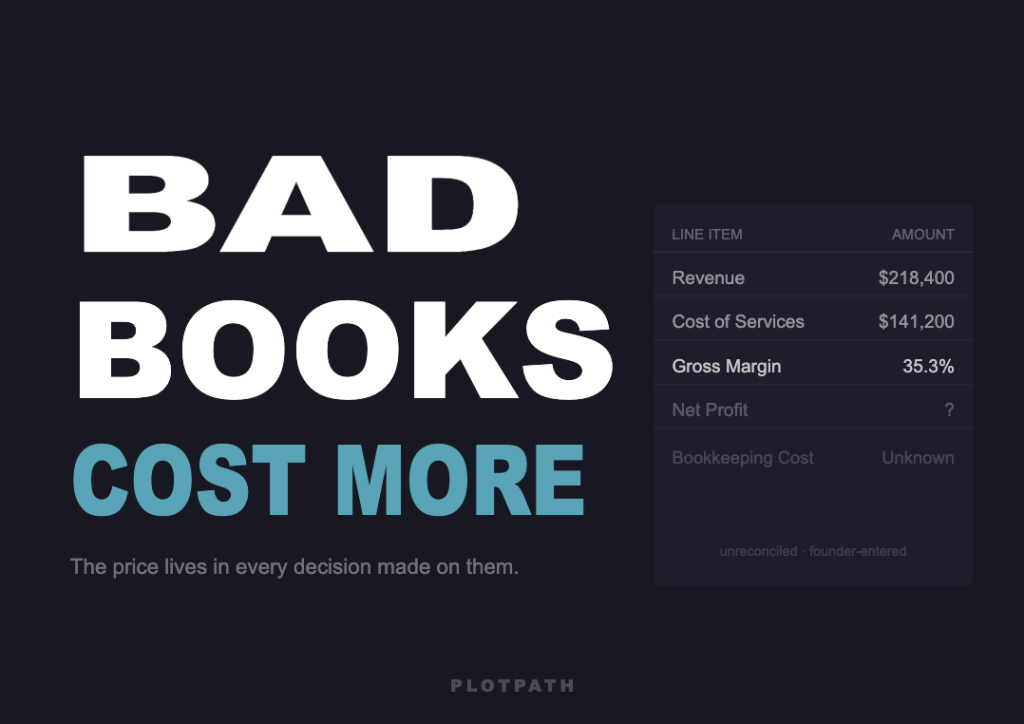
Outsourced bookkeeping for small business is the practice of delegating financial record-keeping, transaction categorization, and monthly close to a trained professional or service outside the company. When done correctly, it removes a high-risk task from unqualified hands and gives owners financial data they can act on with confidence. The common misconception is that handling bookkeeping internally saves money. It does not. It transfers the cost from a visible line item to an invisible one: owner time, misallocated staff capacity, and business decisions built on inaccurate data. When the wrong person holds the books, errors accumulate quietly across months before surfacing in a tax bill, a cash shortfall, or a growth problem nobody can explain. When the right infrastructure is in place, decisions get made from a position of clarity rather than estimation. This article examines why the cheap-bookkeeping trade-off fails, where the real cost lives, and what the correct setup looks like for a service business.
Table of Contents
The Current State of Outsourced Bookkeeping for Small Business
Most service businesses doing $1 million to $10 million in annual revenue are not using outsourced bookkeeping. They are using whoever is available and willing.
The owner does it on Sunday nights. The office manager handles it between answering phones and ordering supplies. An admin who learned QuickBooks by trial and error owns the month-end close. The arrangement persists because the books appear to get done, and the cost of changing it does not feel urgent until something breaks downstream.
This is the default state for small businesses that have outgrown DIY bookkeeping but have not yet made a deliberate decision about what replaces it. The books close. Compliance stays intact. The quality of what is inside them is a separate question that most owners are not asking yet.
The problem is not effort. The people handling the books are often working hard and trying their best. The problem is judgment. Accurate bookkeeping requires consistent application of accounting principles, precise transaction categorization, and the ability to catch errors before they compound into something that distorts every report built on top of them. That is a trained skill. And most small businesses have not put the right person in the role.
The Most Common Small Business Bookkeeping Mistakes
The small business bookkeeping mistakes that cause the most damage are rarely dramatic. They are quiet, consistent, and compounding.
Miscategorized expenses are the most common. A repair cost recorded as a capital asset. A personal charge left inside the business account. A contractor payment filed under the wrong service line. None of these feel significant in isolation. Across a year, they distort gross margin, obscure profit by service, and corrupt every analysis built on top of the data.
Reconciliation gaps are the second most costly pattern. When accounts are not reconciled monthly against bank and credit card statements, the books drift from reality. Cash balances look right until they do not. The discrepancy surfaces at the worst possible moment: during a tax filing, a hiring decision, or when an owner is trying to determine whether the business can sustain its next move.
Late closes create a third category of damage. When the books close 45 or 60 days behind the actual month, the business operates permanently on outdated information. Decisions made in April rest on February data. Cash trends, margin shifts, and early warning signals all arrive too late to act on.
These are not rare exceptions. They are the predictable output of an arrangement where bookkeeping is handled as a secondary task by someone whose primary qualification is something else entirely. The books look done. The accuracy underneath them is not guaranteed.
A Better Framework: Separating the Bookkeeper vs CFO Function
Understanding what the bookkeeper vs CFO distinction actually means in practice is the starting point for building a finance function that works.
A bookkeeper records what happened. They categorize transactions, reconcile accounts, close the month on schedule, and produce accurate financial statements. This is the foundation. Without it, nothing else in the finance function works correctly.
A fractional CFO bookkeeping arrangement builds on that foundation by adding interpretation. Where the bookkeeper records that revenue was $220,000 last month, the CFO-level advisor reads that the gross margin compression visible in the trailing three months is tied to a labor cost shift that will require a pricing adjustment within the next quarter if the owner wants to protect profitability.
These are different functions. They require different skills, different time horizons, and different outputs. Collapsing them into one person, or leaving one of them entirely unaddressed, is where most small business finance setups break down.
Principle 1: Match the task to the person it actually requires
Bookkeeping belongs to a trained bookkeeper. Not the owner, not the office manager, not the admin with QuickBooks access. When the task goes to the right person, accuracy improves, errors are caught at the source, and the close happens on schedule every month without the owner carrying the cognitive load of it.
Principle 2: Treat the books as the foundation of every business decision
Financial reports are not administrative outputs. They are the inputs to every consequential decision the owner makes: whether the business can afford a new hire, whether the pricing structure is producing real margin, whether growth is helping the company or quietly consuming its cash position. Reports built on inaccurate data produce confident decisions with unreliable outcomes. The owner does not know what they do not know.
Principle 3: Separate transactional and strategic finance deliberately
This separation does not happen by default in most small businesses. It has to be designed. A service business doing $2 million in annual revenue can have the same quality of financial clarity as one doing $20 million. The difference is not scale. It is whether the infrastructure was built deliberately or assembled by whoever happened to be available.
What This Means for Service Business Owners
When the right infrastructure is in place, the change is not only operational. It changes how the owner relates to their own business.
Owners who move from informal, in-house bookkeeping to a properly structured setup consistently describe the same shift: they stop guessing and start knowing. The reports arrive on schedule. The numbers reflect reality. Decisions about hiring, investment, and pricing have a clear financial basis rather than a gut estimate dressed up as analysis.
Cash visibility becomes current instead of approximate. The question of whether a hire is affordable has a real answer. Profit by service line becomes visible and actionable. The business stops feeling like a financial black box and starts behaving like a system with readable signals.
One of the most common patterns among service business owners at this revenue range is avoidance. Owners do not open the reports because they do not trust them or cannot interpret what they are seeing. When the books are clean, accurate, and presented in plain language, that avoidance disappears. The financial picture becomes something the owner actively wants to see, because it tells them something useful rather than adding noise.
The cost of outsourced bookkeeping, at the right service level, is often lower than the true cost of the arrangement it replaces. Not because the monthly fee is small, but because the misallocated time, the compounding errors, and the decisions made without accurate data carry costs that most owners do not calculate until they experience what the alternative feels like.
Old vs. New Approaches to Outsourced Bookkeeping for Small Business
| Approach | Pros | Cons | Best For |
|---|---|---|---|
| Owner does the books | No direct monthly cost | Owner time consumed, accuracy risk, strategic thinking crowded out | Businesses under $300K with simple transactions |
| Office manager or admin handles books | Keeps cost internal, someone familiar with the business | Wrong skill set, divided attention, inconsistent accuracy | Short-term gap coverage only |
| Bookkeeping software only | Accessible, low monthly cost | Requires user accuracy, no judgment layer, no interpretation of results | Simple sole proprietors with minimal transaction complexity |
| Outsourced bookkeeper only | Trained, consistent, cost-effective close | No strategic interpretation of what the numbers mean | Businesses needing accurate books without advisory |
| Outsourced bookkeeping plus fractional CFO guidance | Accurate books, owner-ready reporting, CFO-level decision support | Higher monthly cost than bookkeeping alone | Service businesses making consequential financial decisions |
Frequently Asked Questions About Outsourced Bookkeeping for Small Business
Q: What does outsourced bookkeeping for small business typically include?
Outsourced bookkeeping typically includes monthly transaction categorization, bank and credit card reconciliation, financial statement preparation, and a consistent close schedule. Higher-tier services add owner-ready reporting, cash flow visibility, and CFO-level interpretation of what the numbers mean and what to do about them. The scope varies meaningfully by provider, so confirming exactly what is included before starting is worth the conversation.
Q: How much does outsourced bookkeeping for small business cost?
Pricing generally ranges from $300 to $1,500 per month depending on transaction volume, reporting complexity, and whether CFO-level advisory is included. Basic bookkeeping alone sits at the lower end of that range. Services that include monthly reporting and fractional CFO guidance typically start around $500 to $600 per month. The relevant comparison is not the monthly fee in isolation but the full cost of the arrangement it replaces, including owner time and the risk carried by inaccurate books.
Q: What is the difference between a bookkeeper and a CFO, and does a small business need both?
A bookkeeper records and categorizes financial transactions, reconciles accounts, and produces accurate financial statements. A CFO interprets those statements, identifies patterns and risks, and translates the numbers into strategic decisions. These functions are complementary, not interchangeable. A bookkeeper without CFO-level interpretation produces accurate data with no direction. A CFO without clean books underneath spends their capacity fixing transactions instead of reading them. Service businesses making decisions about hiring, pricing, and investment benefit from having both functions in place.
Q: How do I know if my current bookkeeping setup is producing accurate results?
Common signs of inaccuracy include cash balances that do not match expectations, reports that arrive late or inconsistently, unexplained variances between months, and financial statements the owner does not fully trust. A well-functioning setup closes on a consistent schedule, reconciles to the penny each month, and produces reports an owner can read and act on without first needing to question whether the underlying data is correct.
Q: At what revenue level should a service business outsource its bookkeeping?
When a business reaches consistent monthly revenue, employs staff, and is making decisions about hiring, pricing, or investment, the quality of financial data starts to carry real consequences. For most service businesses, that threshold falls between $500K and $1M in annual revenue. Above that level, transaction complexity and decision stakes generally justify a trained bookkeeper over an internal arrangement built for convenience rather than accuracy.
Q: Can a small business actually afford outsourced bookkeeping?
The more useful question is whether a service business at this revenue stage can afford not to have it. Research suggests small business owners spend an average of 10 or more hours per month on financial tasks. At $150 to $200 per hour of owner value, that represents $1,500 to $2,000 in monthly capacity going toward a task a trained bookkeeper handles at a fraction of that cost. Before accounting for decision quality downstream, outsourced bookkeeping for most service businesses at $1M or more in annual revenue costs less than the arrangement it replaces.
Q: What should I look for when choosing an outsourced bookkeeping provider?
Look for a provider with experience in your business type, a defined close schedule and reporting cadence, clear communication standards, and the ability to explain what the numbers mean rather than simply producing them. Providers who offer CFO-level guidance alongside transactional bookkeeping deliver meaningfully more value than those treating the service as a compliance function only. Asking for references from businesses at a similar revenue stage is worth the extra step before committing.
For service business owners making consequential decisions without full confidence in their financial picture, the quality of the bookkeeping underneath those numbers is usually where the problem starts. Getting that foundation right changes what becomes possible above it: decisions made from clarity rather than estimation, a cash picture that reflects reality, and a business that feels navigable rather than opaque.
If you want to understand what a financial operating system built for decision clarity looks like for a service business at your stage, PlotPath publishes practical content on bookkeeping quality, cash visibility, and owner-ready reporting every week.
Follow along at www.plotpath.com.


