
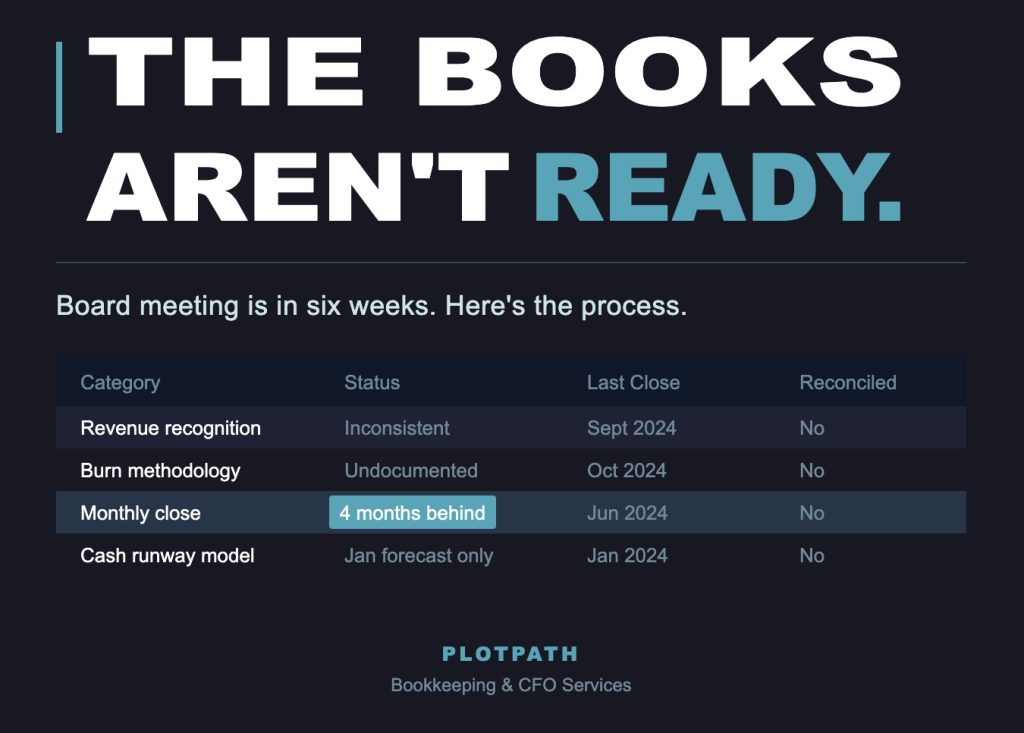
Board-ready financials for startups are the baseline requirement for every board meeting, LP update, and capital raise. They are not a byproduct of having a bookkeeper. They are the result of a specific, sequenced process: a reconciled close, consistent revenue recognition, a verified burn methodology, and a forward cash model tied to real assumptions. When that process exists, a GP can defend the numbers in any room. When it doesn’t, the gap surfaces at the worst possible moment, usually mid-raise or mid-diligence. This guide covers what board-ready financials actually require, why founder-built finance functions rarely produce them, and how VC-backed startups can get there without adding a full-time finance hire.
Table of Contents
What Board-Ready Financials for Startups Really Mean
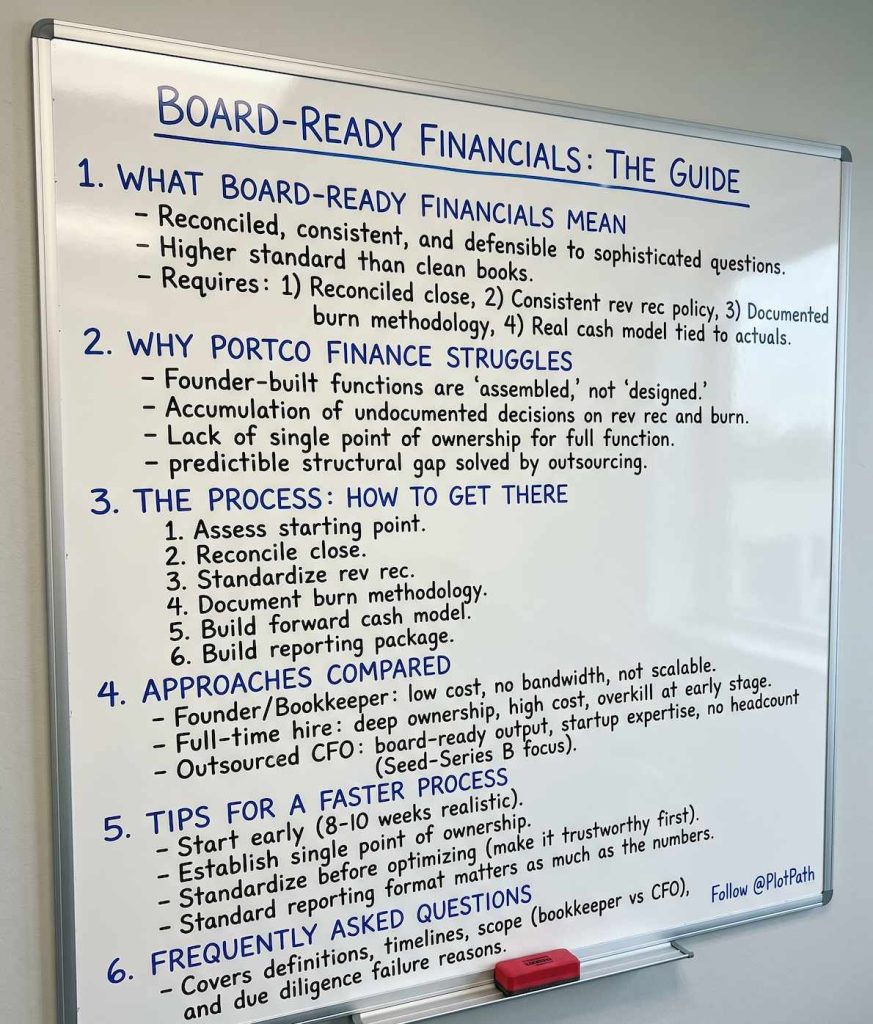
Board-ready financials for startups are not the same as clean books. Clean books means the transactions are recorded. Board-ready means the numbers are reconciled, consistent, and defensible to a sophisticated audience that will ask follow-up questions.
The distinction matters because most portcos have something in between. Transactions are recorded, but revenue recognition shifted mid-year. Payroll is categorized, but differently in Q1 than Q3. The burn number exists, but nobody can explain the methodology behind it in a way that holds up.
A board-ready financial package typically includes:
- A reconciled close through the most recent month
- A consistent revenue recognition policy applied across the full period
- A burn calculation built on a documented, verifiable methodology
- A cash runway projection tied to real actuals, not the January model
- A reporting package the GP and board can read without translation
None of these are complicated in isolation. The problem is that founder-built finance functions rarely produce all five consistently, month after month, under the pressure of everything else a startup is running simultaneously.
Why Portco Finance Functions Struggle to Get There
The finance function at most early-stage startups was not designed. It was assembled. A founder connected a bank account to QuickBooks, hired a part-time bookkeeper, and kept moving.
That works until it doesn’t.
The bookkeeper records transactions but doesn’t own the close. The founder makes judgment calls on revenue recognition that change based on who asked the question. The burn figure in the board deck comes from a spreadsheet the founder maintains separately, using logic nobody else has reviewed.
By the time a board meeting or raise arrives, the portco has months of accumulated decisions that were never documented, never standardized, and never stress-tested against the questions a sophisticated investor will ask.
This is not a people problem. The founders are capable. The bookkeepers are doing their job. The gap is structural: nobody owns the full finance function at the level a board-ready package requires.
Outsourced CFO for startups engagements exist precisely because this structural gap is predictable, consistent across portfolios, and solvable without a full-time hire.
How to Get Portco Books Board-Ready: The Process
Getting a portco from founder-built finance to board-ready financials follows a consistent sequence. The steps below reflect how a structured outsourced finance engagement approaches it.
Step 1: Assess the actual starting point
Before anything can be fixed, the real state of the books has to be established. This means a full review of the close history, the chart of accounts, the revenue recognition methodology in use, and the reconciliation status of every account. Most portcos discover gaps here they didn’t know existed.
Step 2: Reconcile the close
Every account gets reconciled back to the most recent reliable period. Bank accounts, credit cards, payroll accounts, and any intercompany transactions. This step cannot be skipped or accelerated. It is the foundation everything else rests on.
Step 3: Standardize revenue recognition
A single, documented revenue recognition policy gets applied consistently across the full period under review. If the portco has deferred revenue, SaaS subscriptions, or milestone-based contracts, each gets treated according to the same logic. This is the step that most commonly surfaces material adjustments.
Step 4: Build a documented burn methodology
Burn rate is recalculated using a methodology that can be explained to a board member or investor in two sentences. Gross burn. Net burn. What’s included. What’s excluded. Written down. Consistent month over month.
Step 5: Build the forward cash model
A cash runway projection gets built from actuals, not from the original operating plan. It reflects the business as it currently operates, not as it was projected to operate at the start of the year.
Step 6: Build the reporting package
The close, the burn, and the cash model get assembled into a reporting package formatted for a board audience. The GP can read it without translation. The numbers connect. The methodology is visible.
Board-Ready Financials: Common Approaches Compared
| Approach | Pros | Cons | Best For |
|---|---|---|---|
| Founder manages finance directly | Low cost, full context | No bandwidth, undocumented logic, not scalable | Pre-revenue, pre-seed |
| Part-time bookkeeper | Low cost, transaction coverage | No close ownership, no board-level reporting | Early stage, low complexity |
| Full-time finance hire | Deep ownership, full capacity | High cost, slow to hire, overkill at seed/Series A | Series B and beyond |
| Outsourced CFO for startups | Board-ready output, no headcount, startup-specific expertise | Requires coordination, not embedded daily | Seed through Series B portcos preparing for raises or board meetings |
Tips for Getting Portco Books Board-Ready Faster
Getting to board-ready financials faster is mostly about removing the variables that slow the process down. These are the ones that consistently matter.
Start earlier than feels necessary. Six weeks feels like enough time. It rarely is once the reconciliation surfaces issues that need resolution. Eight to ten weeks is a more realistic target for a portco starting from a founder-built baseline.
Establish a single point of ownership. The biggest source of delay is ambiguity about who makes the final call on accounting judgments. Revenue recognition, expense categorization, burn methodology: one person owns each decision and documents it.
Standardize before you optimize. The instinct is to build a better model. The first job is to make the existing numbers trustworthy. Optimization comes after the close is reconciled and the methodology is documented.
Treat VC portfolio finance as a portfolio-level infrastructure problem. Individual portco engagements that start from scratch each time are slower and more expensive than a consistent finance standard deployed across the portfolio from day one of investment.
Require a reporting package format, not just a number. A burn figure without a methodology is not board-ready. A cash runway without actuals underneath it is not board-ready. The format matters as much as the number.
Frequently Asked Questions About Board-Ready Financials for Startups
Q: What does it actually mean for startup financials to be board-ready? A: Board-ready financials for startups means the books are reconciled, the revenue recognition methodology is consistent and documented, the burn calculation can be verified, and the reporting package can be read and defended by a GP in a board meeting without requiring the founder to translate anything. It is a higher standard than clean books and a specific output, not a general condition.
Q: How long does it take to get a portco’s books board-ready? A: For a portco starting from a founder-built finance baseline, eight to ten weeks is a realistic timeline when the process is run by someone with startup-specific experience. Six weeks is possible if the books are relatively current and the revenue recognition issues are limited. Less than six weeks typically means something gets skipped that will surface later.
Q: Can a part-time bookkeeper get a portco to board-ready financials? A: A part-time bookkeeper can keep transactions current, but board-ready financials require close ownership, revenue recognition judgment, burn methodology documentation, and a forward cash model. Most part-time bookkeepers are not scoped or equipped to own all of those outputs simultaneously. The gap is not competence — it is scope.
Q: What is the difference between outsourced CFO for startups and a fractional CFO? A: Outsourced CFO services typically provide the full finance function: bookkeeping, close, reporting, and strategic advisory on an ongoing basis. A fractional CFO is usually a senior advisor who works part-time on strategy but does not own the operational finance function. Startups that need board-ready financials usually need the full function, not just advisory.
Q: Why do portco books consistently fail due diligence even when a bookkeeper is in place? A: Startup books for due diligence fail most often because of revenue recognition inconsistencies, undocumented accounting judgments, and reconciliation gaps that accumulated over time. A bookkeeper who records transactions but does not own the close or the methodology cannot prevent these issues. Due diligence finds them because it asks questions the books were never built to answer.
Q: At what stage should a VC firm require portcos to have a real finance function in place? A: The standard answer is Series A. The more accurate answer is: before the board meeting where the GP has to defend the numbers to an LP or co-investor. That moment arrives earlier than most firms expect, and the cost of fixing undocumented, founder-built finance under deadline pressure is always higher than building it right from the start.
Q: How does PlotPath work with VC-backed startups specifically? A: PlotPath provides bookkeeping, monthly close, board-ready reporting, and CFO-level advisory to VC-backed startups from seed through Series B. The engagement is structured to get portcos to investor-grade financials without a full-time hire, and to maintain that standard on an ongoing basis so board meetings and raises are not a scramble. GPs work with PlotPath to deploy consistent finance infrastructure across their portfolio rather than solving the same problem portco by portco.
For GPs managing a portfolio where portco finance infrastructure is a recurring gap, outsourced finance built specifically for startups can close that gap without adding headcount at each company. If your portcos need board-ready financials before a raise or board meeting, PlotPath provides the close, the reporting, and the CFO-level oversight to get there and keep them there.


