

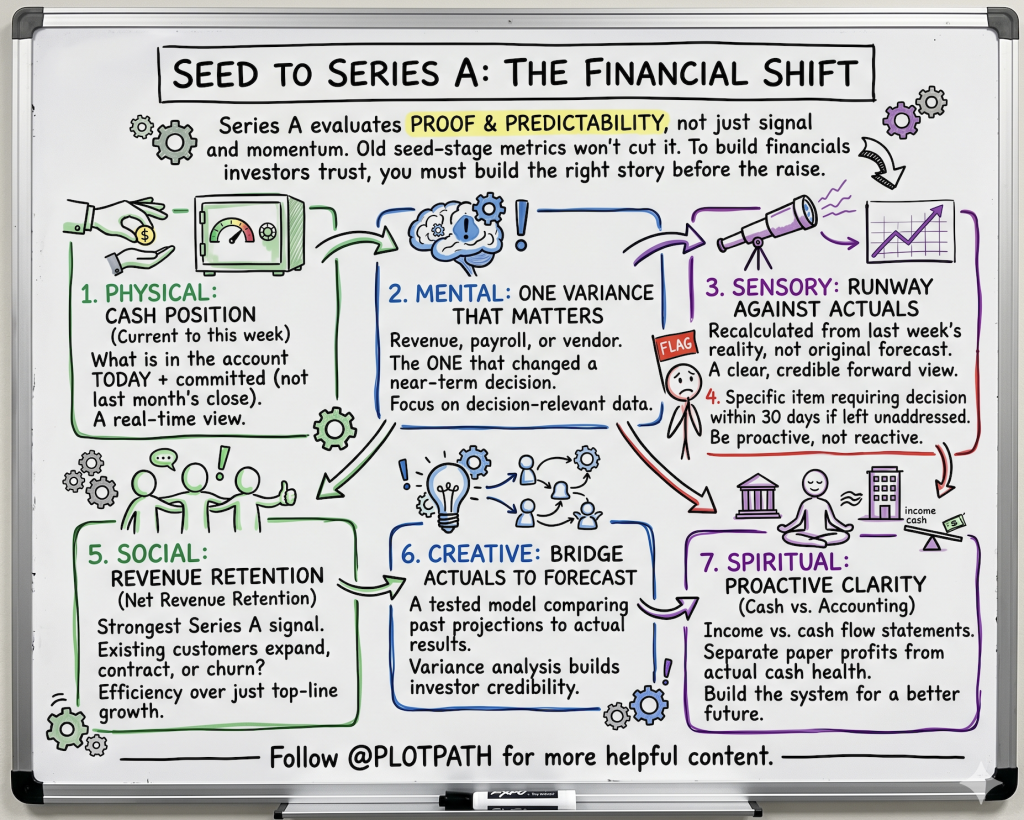
Series A financial metrics represent a fundamentally different measurement standard than those that define a successful seed round. At seed, investors evaluate signal and momentum. At Series A, they evaluate proof and predictability. The common misconception is that a company performing well on seed-stage metrics is automatically ready for Series A scrutiny. It is not. When founders and their advisors understand this shift early, they can build reporting systems that tell the right story before a raise begins. When they miss it, they enter diligence with numbers that are accurate but not relevant to the questions Series A investors are actually asking. This article covers which metrics change at Series A, why seed-stage measurement fails at this stage, and what a better financial framework looks like for companies approaching this transition.
Table of Contents
The Current State of Series A Financial Metrics
Most early-stage companies track what is available, not what is decision-relevant. Revenue growth rate, monthly recurring revenue, customer count, burn multiple — these are the standard instruments of the seed stage. They are meaningful, and for a seed-stage investor evaluating early traction, they are appropriate.
The problem is structural. Seed-stage metrics are designed to answer one question: is there something real here? Series A metrics are designed to answer a different question entirely: can this become a predictable, scalable business?
Those are not the same question. The financial reporting that answers the first question well will often fail to answer the second question at all.
Most founders do not realize the standard has changed until they are already in a raise. By then, reworking the financial narrative under active investor scrutiny is significantly harder than building it in advance.
Why the Old Thinking Fails
The assumption most founders carry into a Series A is straightforward: we have good numbers, so the raise should follow. This sounds right. It often isn’t.
Seed investors make decisions on pattern recognition and founder conviction as much as on financial data. They are comfortable with incomplete information because the company is early. A compelling story, a believable market, and a revenue chart pointing up are often sufficient.
Series A investors are operating from a different starting point. They are committing larger capital into companies expected to deploy it efficiently and return predictable growth. Pattern recognition matters less. Financial structure matters more.
The metrics shift in two important ways at this stage.
First, the time horizon changes. Seed-stage metrics are largely backward-looking: what has happened and at what rate. Series A financial metrics require a credible forward view: what happens to the business over the next 18 to 24 months if the raise closes, and what assumptions is that projection built on.
Second, the quality standard changes. At seed, a founder-assembled model with reasonable assumptions is acceptable. At Series A, investors expect financials that have been tested against actuals, reconciled consistently, and stress-tested across scenarios. A model that has never been compared to what actually happened is not investor-grade. It is a guess with formatting.
When companies enter Series A with seed-stage financial reporting still in place, they create avoidable problems. Diligence takes longer. Questions multiply. Investors who were initially interested begin to flag concerns about operational maturity. Some rounds stall entirely, not because the business is weak, but because the financial narrative does not match the stage the company claims to occupy.
A Better Framework for Series A Financial Metrics
Transitioning from seed-stage measurement to Series A financial metrics is not about adding more reports. It is about changing what the reports are designed to do.
Three principles govern this transition.
Principle 1: Replace activity metrics with efficiency metrics.
Seed stage rewards growth rate. Series A rewards growth quality. The distinction matters more than most founders expect.
Revenue growth rate tells an investor the business is moving. Net revenue retention tells them whether it moves efficiently. Customer acquisition cost tells them what growth costs. CAC payback period tells them whether the unit economics can support the model at scale.
Efficiency metrics are harder to produce because they require clean cost attribution, consistent cohort tracking, and a finance function that separates acquisition spend from retention spend. Most seed-stage companies have not built this. Most Series A investors expect it.
The shift here is not from simple to complex. It is from descriptive to predictive. Efficiency metrics allow an investor to extrapolate the model forward. Activity metrics do not.
Principle 2: Build the bridge between actuals and forecast.
A forecast that has never been tested against actuals is not a financial model. It is an assumption document.
Series A investors evaluate forecast credibility by looking at variance. They want to see what the company projected six months ago and what actually happened. Consistent over-optimism in forecasting signals that the finance function is disconnected from operational reality. Consistent accuracy, or a clear and honest explanation of variance, builds the kind of credibility that survives diligence.
This requires a finance function that closes the books on a reliable monthly cadence, compares actuals to prior projections each period, and documents what changed and why. Most seed-stage companies are not doing this. Building it takes three to six months of consistent execution before it produces data worth presenting to an investor.
Companies that wait until a raise begins to build this bridge do not have time to build it correctly.
Principle 3: Separate cash from accounting.
Profitable on paper and healthy in cash are not the same condition. Series A investors know this. Many seed-stage financial reports obscure the difference.
Accrual accounting, deferred revenue, and timing differences between invoicing and collections can make a company look stronger or weaker than its actual cash position reflects. At Series A, investors want to see both views: the income statement and the cash flow statement, with a clear explanation of where the two diverge and why.
A company with strong revenue growth but deteriorating cash conversion is a materially different investment than the revenue numbers alone suggest. Surfacing this proactively is a mark of financial maturity. Leaving it for an investor to discover mid-diligence is a risk that has ended otherwise strong rounds.
What This Means for Portfolio Companies and the GPs Watching Them
For a venture-backed company approaching Series A, this framework has a direct operational implication. The finance function that served the seed stage is not the finance function that serves the raise.
Seed-stage finance is often founder-led, bookkeeper-supported, and oriented around compliance and basic reporting. That is appropriate for the stage. It is not appropriate for what comes next.
Series A financial readiness requires a finance function that produces investor-grade startup financial reporting on a consistent monthly cadence. It requires a model that has been validated against actuals. It requires clean revenue recognition, documented cost attribution, and a cash flow view that is reconciled and current.
Building this infrastructure takes time. Companies that begin building it six to twelve months before they intend to raise are in a fundamentally different position than companies that begin when the first investor meeting is already scheduled.
For GPs and fund operators watching their portfolio approach this stage, the signal to act is not the raise itself. The signal is the point at which the company’s revenue trajectory makes a Series A conversation realistic within the next twelve months. That is when the finance infrastructure question needs an answer, not when the term sheet is being drafted.
Old vs. New Approaches to Series A Financial Metrics
| Approach | Pros | Cons | Best For |
|---|---|---|---|
| Seed-stage reporting carried into Series A | Familiar, already in place, low setup cost | Fails to answer investor questions, creates diligence friction | Companies not yet approaching a raise |
| Monthly close with actuals-to-forecast variance | Builds credibility over time, investor-ready | Requires 3 to 6 months of execution to produce useful data | Companies 6 to 12 months from a raise |
| Founder-built model without external review | Fast to produce, reflects founder knowledge | Often optimistic, rarely stress-tested, hard to defend in diligence | Internal planning only |
| CFO-level reporting with cost attribution and cash flow view | Strongest for investor confidence and diligence | Higher investment in finance infrastructure | Companies actively preparing for or in a raise |
Frequently Asked Questions About Series A Financial Metrics
Q: What is the most important Series A financial metric investors evaluate? A: Net revenue retention is consistently one of the highest-signal metrics at Series A for recurring revenue businesses. It measures whether existing customers expand, contract, or churn over time, which tells an investor whether the business retains value or requires constant replacement of lost revenue. A company with strong top-line growth but weak net revenue retention has a fundamental unit economics problem that growth alone will not resolve.
Q: How far in advance should a startup prepare its Series A financial metrics? A: Six to twelve months before beginning investor conversations is the practical minimum. Series A financial readiness depends on having actuals compared against prior forecasts, which requires consistent monthly closes over multiple periods. Starting this process after the first investor meeting means the data needed to demonstrate financial credibility does not yet exist in a usable form.
Q: What is the difference between seed stage metrics and Series A financial metrics? A: Seed stage metrics are primarily backward-looking indicators of traction: revenue growth rate, customer count, and burn rate. Series A financial metrics are forward-looking indicators of efficiency and predictability: CAC payback period, net revenue retention, gross margin by segment, and a forecast with documented variance against actuals. The distinction is between demonstrating that something is working and demonstrating that it will continue to work predictably at scale.
Q: What does investor-ready financials mean at Series A? A: Investor-ready financials at Series A means the company’s financial reporting is reconciled, current, and structured to answer investor questions without additional interpretation. This includes a clean income statement with accurate revenue recognition, a cash flow statement that reflects actual timing, a balance sheet that reconciles to bank statements, and a forward model that can be directly compared against historical actuals. Financials that require the founder to explain what they mean are not yet investor-ready.
Q: Why do some Series A rounds stall during diligence? A: Diligence stalls most often when the financial narrative presented in early investor conversations does not survive scrutiny of the underlying data. Common causes include revenue recognition that does not match the model, cost attribution that is inconsistent across periods, a forecast that has never been tested against actuals, or a cash position that diverges significantly from the income statement picture. These issues are correctable, but fixing them under active investor scrutiny is far harder than building clean financials before the raise begins.
Q: How should startup financial reporting change as a company approaches Series A? A: Startup financial reporting should shift from compliance-oriented to decision-oriented as a company approaches Series A. This means moving from monthly reports that describe what happened to reports that compare actuals against projections, flag material variances, and identify forward-looking risks or opportunities. The report should be readable by an investor without a guide. If it requires the founder to translate it, it is not yet doing its job.
Q: What role does cash flow reporting play in Series A financial metrics? A: Cash flow reporting is frequently underweighted by seed-stage companies and closely scrutinized by Series A investors. A company can show strong revenue growth while cash conversion deteriorates due to collections timing, deferred costs, or working capital pressure. Series A investors use the cash flow statement to verify that the income statement reflects operational reality rather than accounting timing. Companies that present both views clearly, and explain where they diverge, demonstrate a level of financial maturity that consistently builds investor confidence.
The companies that raise Series A on the strongest terms are rarely the ones that started preparing when the round opened. They are the ones that built the financial infrastructure before anyone was watching, ran it consistently for several quarters, and walked into investor conversations with a story the numbers could already tell on their own.


