
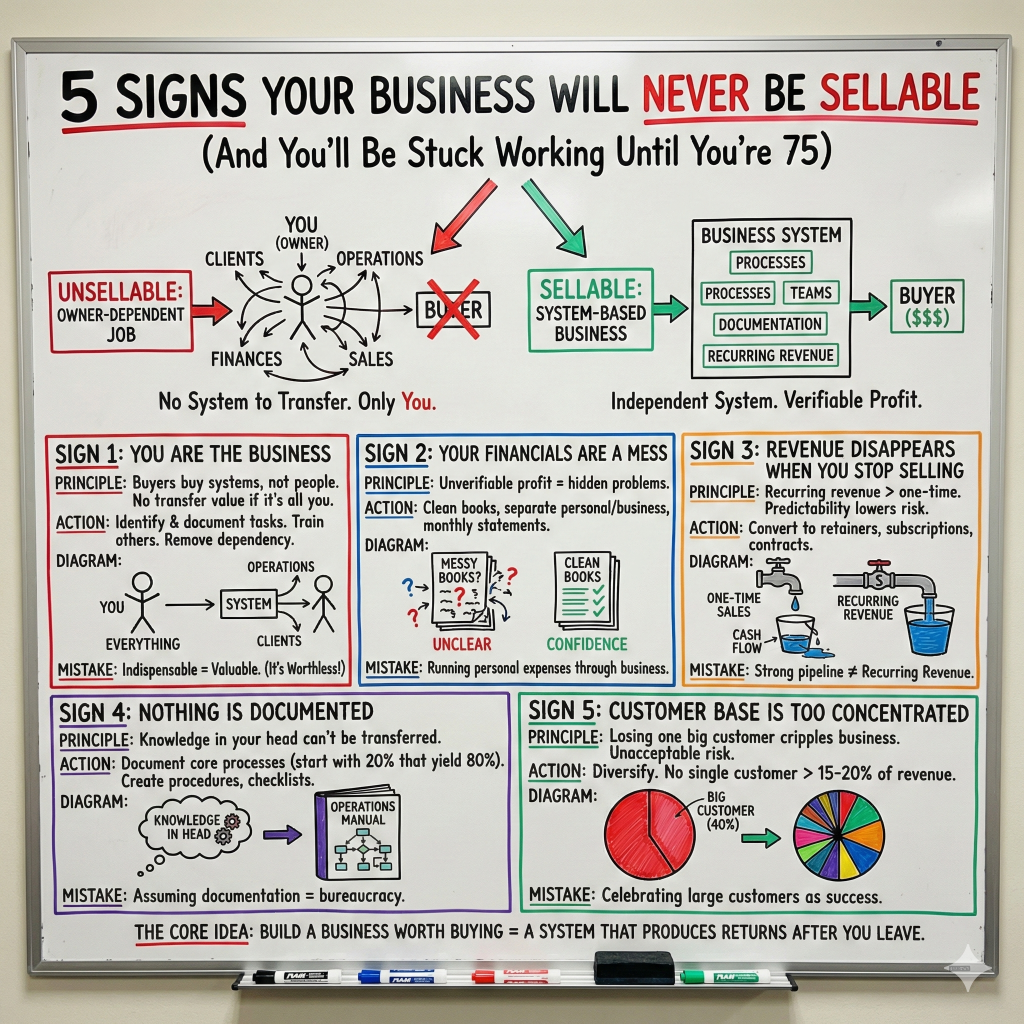
Most business owners assume they will sell their company when they are ready to retire. The reality is different. Research suggests that 70 to 80 percent of businesses listed for sale never find a buyer. The reason is not market conditions or bad timing. It is that most businesses are structured in ways that make them fundamentally unsellable. A sellable business is one that operates independently of the founder, produces consistent and verifiable profits, and offers a buyer something worth paying for beyond the owner\’s personal relationships and expertise. Without these characteristics, what looks like a business is actually just a job the owner happens to own. This article identifies the five warning signs that indicate your business will not sell, explains why each one matters to buyers, and shows what you can do to fix them before you run out of time.
Why Sellability Matters
Owners who plan to retire often count their business as their largest asset. They expect to sell it for three to five times earnings, fund their retirement, and walk away. But a business is only worth what someone will pay for it. And buyers are not buying your effort, your reputation, or your years of sacrifice. They are buying a system that will make them money after you leave.
If your business cannot demonstrate that, the offer will be low or nonexistent. You will face three bad options: keep working indefinitely, close the doors and walk away with nothing, or accept a fraction of what you expected.
The following five signs indicate that your business, as currently structured, will not attract a buyer willing to pay what you need.
5 Signs Your Business Will Never Be Sellable
Sign 1: You Are the Business
The Principle: Buyers purchase systems, not people. If the business depends on you, there is nothing to transfer.
The Action: Identify every function that requires your personal involvement. Document each one. Then systematically train others to perform them or eliminate the dependency.
Why It Works: When a buyer looks at your business, they ask one question: \”What happens when the owner leaves?\” If the answer is \”the business declines,\” the valuation drops to nearly zero. Businesses that run without the founder command premium prices because the buyer is purchasing a machine, not a relationship with you.
The Mistake: Believing that being indispensable makes you valuable. It does the opposite. It makes your business worthless to anyone except you.
Best Use Case: Service businesses where the owner is the primary client relationship holder or technical expert. Start by hiring or training a second person who can serve your most important clients.
Sign 2: Your Financials Are a Mess
The Principle: Buyers cannot pay for profit they cannot verify. Unclear financials signal hidden problems or incompetence.
The Action: Get your books cleaned up and maintained at a level that would survive due diligence. Separate personal expenses from business expenses completely. Produce monthly financial statements that accurately reflect the business.
Why It Works: Acquirers run the numbers before they make an offer. They look at three to five years of financials, examine trends, and identify anything that looks inconsistent. Clean books create confidence. Messy books create doubt, and doubt kills deals or crushes valuations.
The Mistake: Running personal expenses through the business to reduce taxes, then expecting buyers to \”add back\” those expenses to see the real profit. Sophisticated buyers discount these add-backs heavily because they cannot verify them.
Best Use Case: Any business with more than $500,000 in revenue. At this level, the cost of proper bookkeeping and financial reporting is trivial compared to the valuation impact.
Sign 3: Revenue Disappears When You Stop Selling
The Principle: Recurring revenue is worth more than one-time revenue. Predictability reduces buyer risk.
The Action: Identify ways to convert one-time transactions into ongoing relationships. Retainers, subscriptions, maintenance contracts, and membership models all create revenue that continues without constant new sales.
Why It Works: A buyer purchasing your business is making a bet on future cash flows. If those cash flows depend on you personally closing new deals every month, the bet is risky. If 60 percent of revenue recurs automatically, the bet is safer. Safer bets command higher prices.
The Mistake: Assuming that a strong sales pipeline is the same as recurring revenue. It is not. A pipeline requires someone to work it. Recurring revenue arrives whether anyone does anything or not.
Best Use Case: Project-based businesses like agencies, consultancies, and contractors. Even adding a small recurring component (monthly retainers, annual service agreements) improves sellability dramatically.
Sign 4: Nothing Is Documented
The Principle: If the business knowledge lives only in your head, it cannot be transferred. No transfer, no sale.
The Action: Document your core processes. Start with the 20 percent of activities that generate 80 percent of results. Create written procedures, training materials, and checklists that would allow a competent person to run operations without asking you questions.
Why It Works: Documentation is the difference between a business and a set of habits. Buyers need to see that the business can be learned, replicated, and improved by someone other than the founder. Documentation proves this is possible.
The Mistake: Assuming documentation means bureaucracy. It does not. A simple operations manual with clear procedures for your five to ten most important processes is enough to start. Perfection is not required. Existence is.
Best Use Case: Any business where the owner has been operating for more than five years. The longer you have run the business, the more institutional knowledge lives exclusively in your head.
Sign 5: Your Customer Base Is Too Concentrated
The Principle: If losing one or two customers would cripple the business, buyers see unacceptable risk.
The Action: Diversify your revenue base so that no single customer represents more than 15 to 20 percent of total revenue. This may require saying no to additional work from large customers while actively pursuing smaller ones.
Why It Works: Customer concentration is one of the first things buyers examine. A business where the top customer represents 40 percent of revenue is not a business. It is a job serving one client. If that client leaves (and buyers assume they might), the business collapses.
The Mistake: Celebrating large customers as proof of success. Large customers are valuable, but dependence on them is dangerous. The goal is large revenue from a diversified base, not large revenue from a concentrated one.
Best Use Case: B2B service businesses and agencies. These often grow by landing a few big accounts, then struggle to diversify. Start treating diversification as a strategic priority years before you plan to sell.
Patterns Across These Signs
Each of these five signs points to the same underlying problem: the business is not separable from the owner. Buyers want to purchase a system that produces returns. They do not want to purchase a dependency on someone who is about to leave.
Fixing these issues takes time. Most owners need three to five years of intentional preparation before their business is genuinely sellable. Starting earlier gives you options. Waiting until you are ready to retire usually means accepting outcomes you do not want.
Quick Comparison
| Sign | Why Buyers Care | Fix Timeline | Difficulty |
|---|---|---|---|
| You are the business | No transfer value | 2-4 years | High |
| Messy financials | Cannot verify profit | 6-18 months | Medium |
| No recurring revenue | Unpredictable cash flow | 1-3 years | Medium |
| Nothing documented | Cannot be learned | 6-12 months | Low |
| Customer concentration | Unacceptable risk | 2-4 years | High |
Is Your Business Actually Sellable? A Self-Assessment
To get a realistic evaluation of whether your business is positioned to sell, use this AI-powered assessment. Copy and paste it into ChatGPT or Claude, answer honestly, and receive a direct assessment.
AI Prompt for Business Sellability Assessment:
You are a mergers and acquisitions advisor helping a business owner evaluate whether their company is sellable. Ask the following questions one at a time, wait for each answer, then provide an assessment at the end.

Questions to ask:

1. What is your current age?
2. At what age do you want to sell or significantly reduce your involvement in the business?
3. What is your business\'s annual revenue?
4. What is your approximate annual profit (after all expenses, before owner compensation)?
5. How much do you currently pay yourself from the business annually?
6. How many hours per week do you personally work in the business?
7. If you took 90 days off, would the business continue to operate and generate revenue? (Yes/No/Partially)
8. Do you have documented systems and processes that someone else could follow to run the business? (Yes/No/Partially)
9. What percentage of your revenue is recurring (subscriptions, retainers, contracts) versus one-time projects or sales?
10. What percentage of your total revenue comes from your largest single customer?
11. Have you had your business formally valued in the last 3 years? If yes, what was the valuation?
12. Do you have other retirement savings outside the business (401k, IRA, real estate, etc.)? Approximate total value?

After collecting all answers, provide:

1. A sellability score from 1-10, with specific reasoning
2. Which of the 5 warning signs apply to their business (owner dependency, messy financials, no recurring revenue, no documentation, customer concentration)
3. A realistic assessment of what a buyer might actually pay versus what the owner probably expects
4. Three specific actions they should prioritize based on their timeline
5. An honest evaluation of whether their timeline is realistic given the current state

Be direct and realistic. Do not give false reassurance. If the business is currently unsellable, say so clearly while remaining constructive about what can change.
FAQs
Q: What makes a business sellable?
A: A sellable business operates independently of the founder, has clean and verifiable financials, generates predictable revenue, has documented processes, and serves a diversified customer base. Buyers pay for systems that produce returns, not for the owner’s personal involvement.
Q: How long does it take to make a business sellable?
A: Most owners need three to five years of intentional preparation. Some issues (like documentation) can be addressed in months. Others (like reducing owner dependency or diversifying customers) take years of consistent effort.
Q: What multiple can I expect when selling my business?
A: Most small service businesses sell for 1.5 to 3 times annual earnings. Businesses with strong recurring revenue, low owner dependency, and clean financials can command higher multiples. Businesses with the warning signs described here often sell for less or not at all.
Q: Can I sell a business that depends on me?
A: Technically yes, but the price will reflect the risk. Buyers may require you to stay on for an extended transition, reduce the purchase price significantly, or structure the deal with earnouts tied to future performance. None of these scenarios deliver the clean exit most owners want. We have been working with this Sedona Handyman & Home Watch company to help them evolve into a team which is not reliant on its owner.
Q: What if I am close to retirement and my business has these problems?
A: You have three options: extend your timeline to fix the issues, accept a lower sale price or unfavorable terms, or plan to wind down the business and extract income rather than selling it. The sooner you face this reality, the more options you have.
Q: Should I hire a broker to sell my business?
A: A broker can help with the transaction process, but they cannot fix fundamental sellability problems. If your business has the warning signs above, address those first. A broker selling an unsellable business just confirms what buyers already suspected.
Building a Business Worth Buying
For owners who want their business to fund retirement, the principle is straightforward: build something a buyer would want to own. That means removing yourself as a dependency, cleaning up your financials, creating predictable revenue, documenting your operations, and diversifying your customer base.
PlotPath helps service business owners get clarity on where their finances actually stand, so they can make decisions about the future with real numbers instead of assumptions.


