
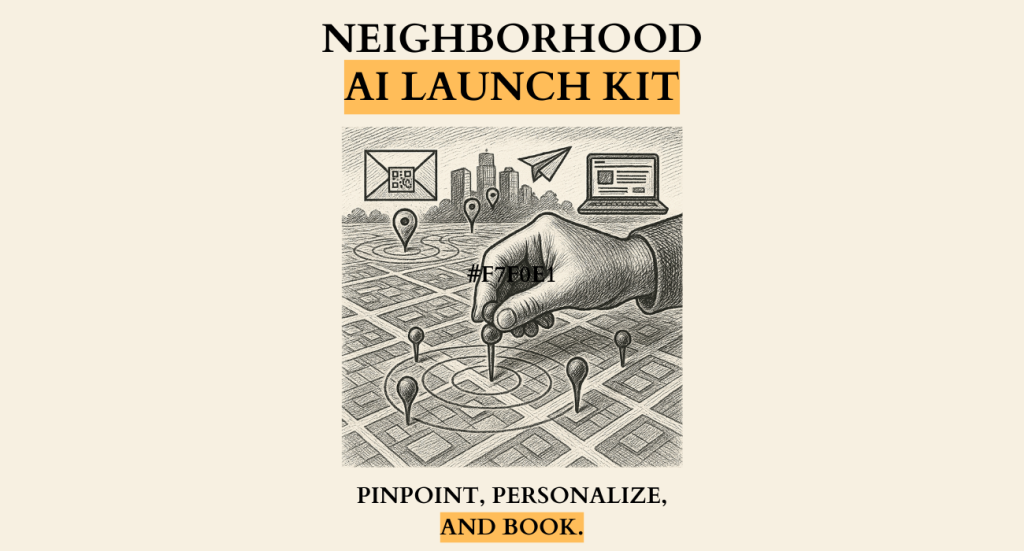
How to launch into a new ZIP code in 7 days with the help of AI.
Why Local Expansion Stalls
Most service businesses hit a ceiling not because of skill or demand, but because they copy and paste the same generic marketing into every market. Each neighborhood has its own tone, landmarks, and micro-culture. If your campaigns sound like they were written for anywhere, they convert nowhere.
AI finally makes it possible to personalize everything, from the postcard headline to the landing page, at the speed of a few well-written prompts.
Step 1: Pick Three ZIPs With Clear Intent
Start small. Choose three neighboring ZIP codes that fit your service area but where you have low visibility. Use data from Google Maps, Yelp, and Nextdoor to identify where homeowners are actively discussing or searching for your service type.
AI tools like ChatGPT or Claude can summarize neighborhood profiles when you feed in local data—median income, housing type, and pain points. This helps shape voice, pricing, and visuals before you ever spend on ads.
Step 2: Create Hyperlocal Messaging With AI
Next, turn those neighborhood insights into specific, resonant copy. AI thrives on context, so include landmarks, schools, or community references in your prompts.
Sample prompt:
“Write a short landing page headline and subhead for a plumbing company serving ZIP 85236 near Seville Park and Riggs Elementary. Focus on speed, trust, and local reputation.”
Use the same approach for Nextdoor posts, Facebook threads, and postcards. A slight shift in local language can double your engagement rate.
Step 3: Build Collateral in a Single Afternoon
AI image tools can generate realistic neighborhood imagery—driveways, mailboxes, or local streets—without copyright issues. Combine these visuals with AI-written text to produce a full set of launch assets:
- Postcards: Neighborhood reference + trackable QR code
- Nextdoor posts: Conversational threads with quick replies
- Landing page variants: One per ZIP with address proof and trust signals
- Email sequence: Intro, local proof, offer, and reminder
Sample prompt:
“Write a 65-word postcard for an HVAC tune-up offer in ZIP 85234. Include a $49 intro price, mention Freestone Park, and end with a QR code CTA to book online.”
Step 4: Automate Testing and Tracking
Don’t guess which ZIP is working. Use a simple spreadsheet or CRM tag to track ad spend, leads, and close rate by neighborhood. AI can summarize the data weekly and flag which ZIPs outperform the rest.
Prompt example:
“Summarize this table of ZIP performance and rank by cost per booked job. Suggest two tests to improve conversion in the lowest ZIP.”
Step 5: Scale The Winner
When one ZIP clearly wins, double down. Update your service pages, Google Business Profile, and review requests to highlight that area. Then rinse and repeat with the next cluster of neighborhoods. The system compounds quickly once it’s dialed in.
Measure What Matters
Track the results like any campaign: QR scans, new estimates, close rates, and repeat bookings. The real power of AI is not just faster copy—it’s the ability to see, test, and adjust your local marketing like a data-driven pro.
Takeaway: You don’t need a big agency to grow into new ZIP codes. You need AI-driven precision, local insight, and a repeatable system. Start small, launch fast, and watch your neighborhood leads multiply.


