
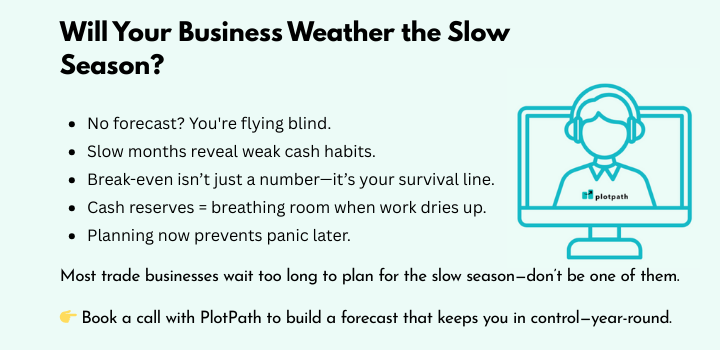
Use Financial Forecasting to Find Out
It’s the same stress every year: your busy season ends, invoices slow down, and you start to wonder if you’ve got enough in the tank—cash, crew, and confidence—to make it through the off-season. Trade businesses live and die by seasonality. But that doesn’t mean you have to live in panic mode during your slower months. With smart financial forecasting, you can plan ahead, stay in control, and make the slow season a strategic part of your year, not a financial emergency.
In this post, we’ll break it down and show you how to take the next step toward financial clarity.

What Is Financial Forecasting—and Why Seasonal Businesses Need It
Financial forecasting is the process of using historical data, current trends, and future expectations to predict your business’s financial performance. That includes cash flow, revenue, expenses, and profitability. It’s not about being perfect—it’s about being prepared.
For seasonal businesses like HVAC, landscaping, pool service, or construction trades, forecasting is critical because revenue isn’t consistent year-round. If your team and equipment costs stay flat, but your income drops during the winter (or summer), you need a plan to cover that gap.
Forecasting helps you figure out:
-
How much cash you’ll need on hand to make it through the off-season
-
What your breakeven point is during slower months
-
Whether you can afford to keep your team fully staffed
-
When to schedule major purchases or hold off on expansion
Why This Matters More Than You Think
Without forecasting, most business owners are just guessing. They look at the checking account balance and make short-term decisions without a bigger picture. That leads to poor timing, rushed hiring (or layoffs), and missed opportunities.
Let’s say you run a landscaping business. Spring and summer are slammed, but by October, leads slow down. You still have trucks, payroll, and equipment payments due every month. If you knew back in July that you\’d need $80K to cover fixed costs through the winter, would you have put more aside? Delayed a vehicle purchase? Taken on a profitable project even if it meant longer hours?
With a forecast, you can model those decisions in advance and avoid being reactive. You’ll know when and where the squeeze is coming—and you can plan around it.
The Common Pitfalls of Seasonal Business Planning
One of the biggest mistakes seasonal business owners make is only looking backwards. Past years’ financials are helpful, but they don’t replace a forward-looking plan. Another is relying solely on gut instinct. That might work for one season, but it’s not sustainable if you’re trying to grow.
Here’s what we see too often:
-
Underestimating how long the slow season will last
-
Overestimating future sales based on a single good month
-
Forgetting to factor in one-time costs like tax payments or insurance renewals
-
Not calculating the true breakeven point in slower periods
If you don’t know your monthly breakeven number—including fixed overhead and variable costs—you’re flying blind. You might have months where you\’re working hard but still losing money without realizing it.
How to Plan Ahead: Forecasting in Four Key Steps
-
Review Your Historical Data
Look at the last 2–3 years of monthly revenue and expenses. Identify when your slow periods hit, how deep they go, and how long they last. This gives you your baseline. -
Build a 12-Month Forecast
Use your data to map out revenue and expenses month by month. Be conservative. Don’t assume every job will close. Account for seasonality and realistic pipeline conversion rates. -
Calculate Breakeven for Each Month
Determine your fixed and variable costs. Figure out exactly how much revenue you need each month to cover expenses—especially during your slowest months. -
Plan for Cash Reserves
Once you know the forecasted shortfall, you can set aside cash during your busy season to cover it. Ideally, build a reserve that covers at least 2–3 months of fixed costs.
Even small improvements here can make a big difference to your bottom line. We help clients do this every day—and the relief they feel when they stop guessing is palpable.
How PlotPath Helps Trade Businesses Stay Ahead
At PlotPath, we work with seasonal trade businesses to make sure they’re not caught off guard. From strategic bookkeeping that accurately categorizes seasonal spending, to custom KPI dashboards that track working capital and cash runway, we give you the tools to see what’s coming—and prepare for it.
Our Virtual CFO services go deeper. We help you model different scenarios, plan major expenses, and make confident hiring and investment decisions even when the forecast is cloudy.
If you’re ready for better financial visibility and less stress around the numbers, book a call with PlotPath today.
Final Thought
The slow season doesn’t have to be scary. With the right financial forecasting tools and guidance, it can be just another part of your business cycle—one you’re fully prepared for. You don’t have to figure this out alone. PlotPath can help you make smarter decisions, manage growth, and improve profitability—starting today.


