
How to Choose
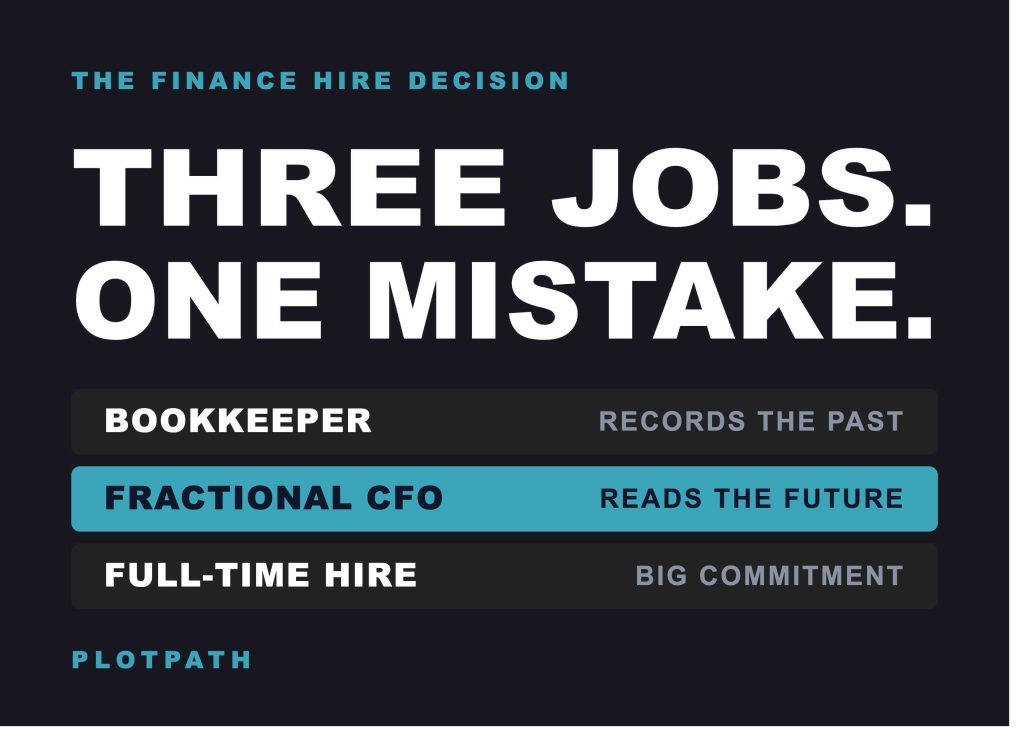
The bookkeeper vs fractional CFO decision confuses most business owners because the two roles look similar and do opposite jobs. A bookkeeper records what already happened to your money. A fractional CFO interprets what those numbers mean and tells you what to do next. The two are not interchangeable, and hiring one when you needed the other is the most common and most expensive finance mistake owners make.
Owners usually frame this as a single purchase: which one do I hire. The better frame is a sequence. Clean records come first, financial interpretation comes second, and a full-time finance seat comes last, only when volume justifies the salary. Get the order wrong and you either overpay for capacity you don’t need or underbuy and call it a strategy.
This article breaks down what a bookkeeper, a fractional CFO, and a full-time hire each actually do, what each costs, and how to tell which role your business needs right now.
Quick Answer: Which Role Do You Need
Most owners between $1M and $10M in revenue are short on interpretation, not records. Here is the fast version.
Choose a bookkeeper if your books are messy, late, or untrusted and you need accurate records before anything else. This is the foundation, not the finish line.
Choose a fractional CFO if your books are reasonably clean but you still can’t answer questions like where cash runs thin in four months or which service line is quietly losing money. This is where most growing owners actually live.
Choose a full-time finance hire if your transaction volume, team size, and complexity have outgrown what an outside partner can handle, usually well past the early growth stage. This solves a capacity problem, not a clarity problem.
The rest of this guide explains why these are different jobs and how to avoid paying for the wrong one.
What a Bookkeeper Actually Does
A bookkeeper records the past. They make sure every dollar that moves through your business is logged, categorized, and reconciled against your bank and credit accounts. Done well, this produces clean financial statements you can trust.
That trust is the entire point. You cannot make a confident decision on numbers you don’t believe, and messy data dressed up as clean data is worse than no data at all. Reliable books are the floor every other financial decision stands on.
But a bookkeeper answers one kind of question: what happened. They will tell you what you spent on payroll last month and what a client paid in March. They are not trained, and usually not hired, to tell you what those numbers mean for the decision sitting in front of you.
This is where the first mismatch happens. Owners hire a bookkeeper, get clean reports, and then feel frustrated when those reports don’t guide their next move. That frustration is misdirected. The bookkeeper did their job. The job of interpretation belongs to someone else.
What a Fractional CFO Actually Does
A fractional CFO interprets the future. They look at the same numbers a bookkeeper produced and translate them into decisions. The work is part-time and shared across several companies, which is why a growing business can access senior financial judgment without paying a senior full-time salary.
When you need to hire a fractional CFO, you are buying a different brain, not a faster bookkeeper. A fractional CFO answers questions like these. Where does cash get tight over the next two quarters. Which clients or services actually drive profit once you account for their true cost. What the next hire really costs you against your runway. Whether this growth is strengthening the business or quietly straining it.
The distinction matters because clean books are history. A fractional CFO turns that history into forward control. They convert a stack of accurate reports into a short list of clear, decision-grade signals about what to do next.
This is the role most owners doing $1M to $10M are missing, and the one almost nobody sells cleanly. So owners reach past it for a full-time hire or settle below it with a bookkeeper, and the clarity gap never closes.
What a Full-Time Finance Hire Actually Does
A full-time hire is a commitment, not a shortcut to clarity. Bringing finance fully in-house, whether a controller or an in-house CFO, solves a volume and complexity problem. It makes sense when your transaction count, reporting demands, and team have grown large enough that a dedicated salary is cheaper than an outside partner.
The mistake is reaching for this seat too early. Owners treat a full-time hire as the most serious option and assume serious problems require it. But hiring a full-time CFO at a few million in revenue often means paying full-time money for part-time work, and watching the runway shrink while you do it.
When you weigh fractional CFO vs full-time CFO, the real question is not which is more capable. It is which matches your current stage. A full-time hire bought too soon is capacity you cannot yet use, dressed up as progress.
Key Differences: Bookkeeper vs Fractional CFO
The bookkeeper vs fractional CFO comparison comes down to four things: what they look at, what question they answer, what you walk away with, and what it costs.
What they look at. A bookkeeper looks backward at recorded transactions. A fractional CFO looks forward at what those transactions predict.
What question they answer. A bookkeeper answers what happened. A fractional CFO answers what to do about it.
What you walk away with. A bookkeeper gives you accurate statements. A fractional CFO gives you a decision, with the reasoning behind it.
What it costs. A bookkeeper is a relatively low monthly cost for records. A fractional CFO costs more than a bookkeeper but a fraction of a full-time executive, because the time is shared.
The trap is assuming clean books deliver the second column on their own. They do not. Accurate records are necessary for clarity and nowhere near sufficient for it.
Side-by-Side Comparison
| Role | What It Does | Best For | Watch Out For |
|---|---|---|---|
| Bookkeeper | Records and reconciles past transactions | Owners needing accurate, trusted books | Expecting decision guidance it can’t give |
| Fractional CFO | Interprets numbers into forward decisions | Owners who have books but lack clarity | Hiring before books are reliable |
| Full-Time Hire | In-house capacity for high volume | Larger, more complex operations | Buying the salary too early |
| Controller | Runs the financial system day to day | Growing teams needing process and oversight | Confusing it with strategic guidance |
The Fourth Role Most Owners Forget
There is a role that sits quietly between the bookkeeper and the CFO: the controller. A controller owns the financial system itself. They manage the close, enforce the process, supervise the bookkeeping, and make sure reporting is accurate and on time.
Most owners doing $1M to $10M do not need four separate hires. They need to understand which single job they are actually short on. Usually it is one. The reason the decision feels overwhelming is that owners treat four distinct roles as one fuzzy category called “finance help” and then shop for it like a single product.
Naming the roles separately is most of the solution. Once you can see that recording, running the system, interpreting, and committing to headcount are four different jobs, the question stops being “who do I hire” and becomes “which gap am I trying to close.”
When to Hire a Fractional CFO
Knowing when to hire a fractional CFO is mostly about recognizing a specific kind of frustration. Your books are reasonably clean, but you still make consequential decisions on instinct because the reports don’t translate into guidance.
A few signals that you have reached this point. You are making hiring, pricing, or investment decisions without trusting your financial picture. Cash feels unpredictable even though the business is profitable on paper. You can see what happened last month but not what is coming next quarter. Growth is happening, and you genuinely cannot tell whether it is helping or hurting.
These are not bookkeeping problems. More records will not fix them, and adding a full-time salary is an expensive way to discover that. They are interpretation problems, which is exactly the work a fractional CFO exists to do.
The timing rule is simple. Clean books first, because interpretation built on bad data is just confident guessing. Then the clarity layer. The full-time seat comes only when volume forces it, not when frustration peaks.
Which Should You Choose
Start by diagnosing the gap honestly. If you do not trust your numbers, your problem is records, and a bookkeeper or controller comes first. No amount of strategic advice survives unreliable data underneath it.
If you trust your numbers but still feel like you are guessing on the decisions that matter, your problem is interpretation, and a fractional CFO is the fit. This is the most common real answer for owners in the $1M to $10M range, and often the one they skip over.
If you have outgrown what shared, part-time support can deliver, and the volume genuinely justifies a dedicated salary, then a full-time hire earns its seat. Most owners reach this point later than they assume.
The decision was never really about choosing a person. It was about naming the job. Hire for the gap you actually have, in the order the work requires, and you stop overpaying for the wrong one.
Frequently Asked Questions About the Bookkeeper vs Fractional CFO Decision
Q: Do I need a bookkeeper or a CFO first? A: A bookkeeper first, in almost every case. A fractional CFO interprets financial data, and that interpretation is only as good as the records underneath it. Clean, trusted books are the foundation that makes CFO-level guidance reliable.
Q: Can a fractional CFO do my bookkeeping too? A: Usually not directly, and you would not want to pay CFO rates for it. Many fractional CFO arrangements include or oversee bookkeeping as part of a broader system, but the two functions remain distinct jobs even when delivered together.
Q: How is a fractional CFO different from a full-time CFO? A: The work is similar but the commitment is not. When comparing fractional CFO vs full-time CFO, the fractional model gives you senior financial judgment part-time and shared across companies, at a fraction of a full salary. A full-time CFO makes sense once volume and complexity justify the dedicated cost.
Q: Is a fractional CFO worth it for a small business? A: It depends on whether your problem is records or decisions. If you have clean books but still make major calls on instinct, a fractional CFO addresses the exact gap. If your books are still unreliable, fix that first.
Q: When should I hire a fractional CFO instead of a bookkeeper? A: When your books are accurate but no longer answer your real questions. The trigger for when to hire a fractional CFO is making consequential decisions, hiring, pricing, large purchases, without a financial picture you trust to guide them.
Q: Won’t hiring a full-time finance person solve everything at once? A: Not necessarily, and often not affordably. A full-time hire solves a capacity problem. If your actual problem is clarity rather than volume, you may pay a full salary and still lack the forward-looking guidance you wanted.
Keep Going
Clarity rarely comes from adding more numbers. It comes from understanding which job you are actually short on, then closing that one gap in the right order.
If you want more thinking like this, on cash reality, profit drivers, and making decisions you can trust, that is the work we publish in our newsletter, The Owner’s Edge. It is written for owners who want signal over noise, not another dashboard to ignore.
Book a complementary discovery call: www.plotpath.com/discovery-call


