
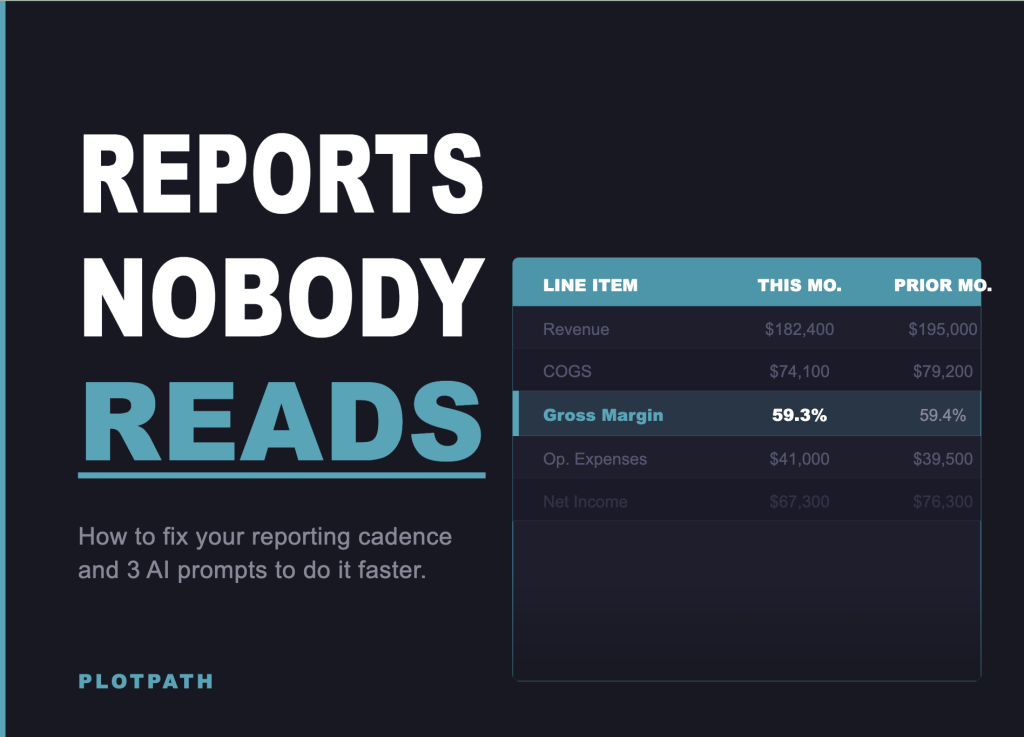
Building financial reports your team understands is a process of translating raw accounting data into clear, decision-ready information that the people running your business can act on without a finance degree. Most financial reports fail not because the numbers are wrong, but because they are formatted for accountants rather than operators. When reports are built around the questions your team is actually asking, they get used. When they are built around accounting conventions, they get filed away. This article covers how to structure your monthly close process, establish a financial reporting cadence that sticks, and use three AI prompts to build owner-ready reporting faster and with fewer errors.
Table of Contents
What Financial Reports Your Team Understands Really Mean
Financial reports your team understands are not simplified reports. They are correctly prioritized reports. The numbers do not change. What changes is the order, the framing, and the context around them.
Most businesses produce three standard outputs from their monthly close: a profit and loss statement, a balance sheet, and a cash flow statement. These are correct and necessary. They are also nearly useless for weekly decision-making without translation.
Owner-ready reporting adds a layer between the raw financials and the people making decisions. That layer answers three questions:
- Where does cash actually stand today, and where is it likely to be in 60 days?
- Which parts of the business are profitable, and which are dragging the margin?
- What changed this month, and does it signal a pattern or just a one-time event?
When those three questions are answered clearly, the reports get read. When they are not, the reports sit in an email folder.
Why Financial Reports Fail Before Anyone Reads Them
The most common reporting failure is not inaccuracy. It is irrelevance. Reports that arrive two weeks after the period closes cannot inform decisions that were made last week. Reports that present 40 line items with no prioritization create noise instead of signal.
There are three patterns that consistently produce reports nobody trusts.
The timing problem. A monthly close that finishes on the 22nd of the following month gives the business 8 days of useful context before the next period is already underway. A close that finishes on the 8th gives the team three weeks to act on what they learned. Closing speed directly determines reporting value.
The format problem. Most off-the-shelf financial reports are structured for a CPA reviewing compliance. An owner reviewing performance needs the opposite: cash first, profit by service line second, notable variances third. Format determines whether a report answers the right question or forces the reader to hunt for it.
The context problem. A number without a benchmark is almost meaningless. Revenue of $180,000 this month sounds good until you know the target was $210,000 and last year it was $195,000. Every key figure in a report should carry a reference point: prior month, prior year, or the number you were aiming for.
When any one of these three problems is present, trust erodes. When all three are present, the report stops getting opened.
How to Build Financial Reports Your Team Understands: Step-by-Step
The steps below describe how to build a reporting structure from scratch or reset one that has stopped working.
Step 1: Anchor the Monthly Close Process to a Hard Deadline
A financial reporting cadence is only as reliable as the close process behind it. Set a close deadline before you design any report. For most service businesses, a close completed by the 8th to 10th of the following month is achievable and gives the team meaningful decision time.
Work backward from that date. Identify what has to be done and in what order: bank reconciliations, accounts receivable aging review, payroll reconciliation, credit card categorization, and intercompany or owner transaction cleanup. Each task gets an owner and a due date inside the close window.
Step 2: Identify the Three to Five Questions Your Team Asks Every Month
Before building a report template, ask the people who will read it what they actually need to know. Common answers from service business operators include: Do we have enough cash to make payroll next month? Which jobs or service lines are making us money? Are we on track for the revenue target we set? Are our margins holding or slipping?
Each question maps to a specific section of a well-built report. Build the report structure around those questions, not around the chart of accounts.
Step 3: Build a One-Page Executive Summary First
The executive summary is the report most of your team will actually read in full. It sits at the top of the reporting package and answers the three questions from the previous section in plain language. No accounting terms. No unexplained variances. A short narrative paragraph followed by four to six key figures with benchmarks.
If the full financial report is the source document, the executive summary is the translation. Both belong in the package. The summary gets read first; the detail gets referenced when something in the summary raises a question.
Step 4: Standardize the Format and Never Change It
Trust is built through repetition. When the report looks different every month, readers spend cognitive effort reorienting themselves instead of absorbing the numbers. The format should be locked: same order, same sections, same layout, same date it arrives in inboxes.
This sounds simple. It requires discipline. The temptation when something unusual happens is to restructure the report to explain it. Resist that. Use the narrative section to explain anomalies. Keep the structure identical.
Step 5: Add Benchmarks to Every Key Figure
Every number that matters needs a reference point. Structure your key metrics section with three columns: this month, prior month, and prior year (or target). That three-column format turns a static number into a signal. It makes trends visible without requiring the reader to do mental math or remember last month’s report.
Step 6: Create a Standing Financial Reporting Cadence
A report delivered on request is consulted. A report delivered on a fixed schedule becomes part of how decisions get made. Set a standing delivery date each month, a standing review meeting with whoever needs to be in the room, and a simple feedback loop so the report improves over time.
The cadence does not have to be elaborate. A monthly package delivered by the 10th, reviewed in a 30-minute meeting by the 15th, and followed by one action item per key finding is more effective than a quarterly deep dive nobody prepares for.
Financial Reporting Approaches Compared
| Approach | Pros | Cons | Best For |
|---|---|---|---|
| Raw accounting exports (P&L, BS, CF) | Complete, audit-ready | Hard to act on without interpretation | CPA review, tax prep |
| Dashboard tools (QuickBooks, Fathom) | Visual, accessible | Requires clean data; often lags behind | Quick reference |
| Owner-ready monthly report package | Decision-focused, narrative context | Requires build time and ongoing maintenance | Weekly operating decisions |
| Executive summary only | Fast to read, easy to share | Loses detail needed for investigation | Leadership review |
| AI-assisted reporting | Faster drafting, better pattern flagging | Requires accurate source data | Accelerating existing process |
3 AI Prompts to Build Better Reports Faster
AI does not replace the judgment behind a good report. It removes the friction that slows down production of one. These three prompts are designed to slot into your existing monthly close process.
Prompt 1: Draft the executive summary narrative
Use this after your close is complete and your key figures are finalized.
“I am preparing the monthly financial summary for [business name] for [month]. Here are the key figures: revenue was $[X] vs. a target of $[X] and prior month of $[X]. Gross margin was [X]% vs. [X]% last month. Operating cash on hand is $[X], up/down from $[X]. Notable items this month include [list 1-2 anomalies or one-time items]. Write a 3-4 sentence plain-language executive summary that explains what happened, whether it reflects a trend or a one-time event, and what the business should watch next month.”
Prompt 2: Flag variances worth investigating
Use this when you have a full P&L export and want to identify what needs a closer look before your review meeting.
“Here is my profit and loss statement for [month] compared to [prior month / same month last year]. Identify any line items where the variance exceeds 15% or $[X], whichever is larger. For each, note whether the change is likely timing-related, volume-related, or a potential data entry issue. Format your response as a short list: line item, variance amount, and a one-sentence hypothesis for what caused it.”
Prompt 3: Improve report clarity for a non-finance reader
Use this when your report is built but you want to stress-test whether it communicates clearly to someone without a finance background.
“Here is the executive summary section of our monthly financial report: [paste text]. Rewrite this for a business owner who is not a financial expert. Remove accounting jargon. Replace passive voice with direct statements. Ensure each sentence answers either ‘what happened,’ ‘why it happened,’ or ‘what we should do about it.’ Keep the rewrite under 150 words.”
These prompts work because they apply AI to the translation layer, not the accounting layer. The numbers still need a human close. The narrative benefits from a fast, consistent drafting assist.
Tips for Better Financial Reporting Results
- Close every month on the same timeline. Consistency in the close produces consistency in the report.
- Keep the executive summary under one page. If it runs longer, the most important finding is probably buried.
- Send the report before the review meeting, not during it. Reading time in a meeting is wasted meeting time.
- Flag the one number that changed most significantly and say why in plain language. Every report needs one clear headline.
- Build the report template once and protect it. Format drift is the enemy of trust.
- If a section of the report is never discussed in review meetings, cut it. Reports earn attention by being useful, not comprehensive.
- Review the report yourself before it goes out. The question to ask is: if I knew nothing about this month, would this report tell me what I need to know?
Frequently Asked Questions About Financial Reports Your Team Understands
Q: How long should it take to close the books each month? A: For most service businesses doing $1M to $10M in revenue, a monthly close completed within 7 to 10 business days of the period end is realistic and sufficient for timely decision-making. Longer close cycles typically indicate missing source documents, unreconciled accounts, or insufficient bookkeeping capacity. A well-structured close checklist with clear ownership for each task is the fastest way to shorten the cycle.
Q: What should a monthly financial report package include? A: A complete monthly financial report package for a service business typically includes an executive summary in plain language, a profit and loss statement with prior period and year-over-year comparisons, a cash flow summary or 60-day cash projection, accounts receivable aging, and a brief narrative on key variances. The executive summary is the most important piece because it determines whether the rest of the package gets read.
Q: Why do financial reports your team understands matter more than accurate ones? A: Accuracy is the floor, not the goal. A report that is accurate but not understandable produces the same outcome as no report: decisions made without financial context. Financial reports your team understands are accurate reports that are also formatted, prioritized, and framed in a way that connects the numbers to the decisions the team needs to make. Both qualities are required for a report to change behavior.
Q: How often should we review financial reports as a team? A: Monthly review meetings tied to the close cycle are the minimum effective cadence for most businesses. The meeting does not need to be long. A 30-minute structured review of the executive summary, one to two key variances, and one forward-looking question is more valuable than a quarterly deep dive with no standing agenda. Businesses that review financials monthly make better decisions than those that review quarterly, because the feedback loop between action and result is shorter.
Q: Can AI tools replace a bookkeeper or CFO in the reporting process? A: No. AI tools accelerate the drafting and analysis of financial reports, but they depend on accurate, reconciled source data that requires human oversight to produce. AI is most useful in the translation layer: turning finalized numbers into plain-language narratives, flagging variances worth investigating, and stress-testing reports for clarity. The close process, the accounting judgment, and the strategic interpretation of what the numbers mean still require a qualified human.
Q: What is the most common reason financial reports stop getting read? A: The most common reason is irrelevance caused by timing. When a report arrives two to three weeks after the period it describes, the decisions that could have been informed by that data have already been made. The second most common reason is format: reports that present data in accounting order rather than decision-priority order require too much effort to extract value from. Both problems are fixable through process changes rather than better software.
Q: How do I get my team to actually use the financial reports I send them? A: Build the report around the questions your team is already asking, not around standard accounting outputs. Deliver it on a fixed schedule so it becomes an expected input to decision-making. Follow delivery with a standing meeting so there is a structured moment to engage with the numbers. And keep the executive summary to one page: the shorter and clearer the entry point, the higher the read rate.
Keep Building on What You Know
Financial reporting done well is not a finance problem. It is a communication and process problem. When the close runs on time, the format is consistent, and the numbers are translated into plain language, the report becomes a tool people reach for instead of one they avoid.
If you want to go deeper on the financial reporting cadence that fits a growing service business, PlotPath publishes practical content on bookkeeping, cash flow, and financial decision-making for owners who want clarity without the complexity. Follow along at plotpath.com.


