
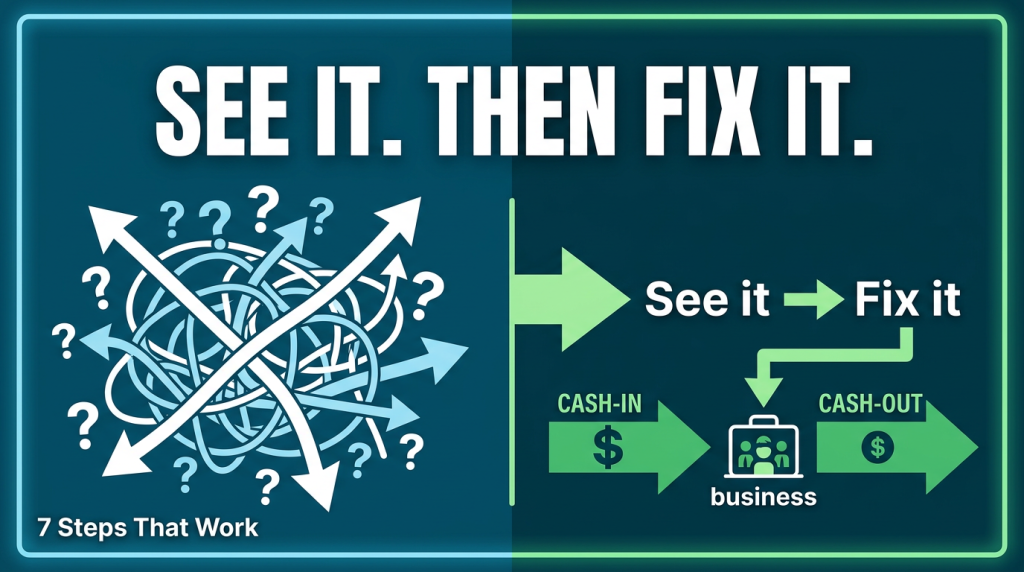
The fastest way to fix cash flow problems in a small business is to see where the money goes before you change anything. Most owners reach for levers (cut costs, chase receivables, delay payables) without a clear picture. That turns into reaction, not control. When you fix visibility first, the same levers work better because you know which ones to pull. This article walks through seven steps that build on that order: see the reality, then act on it.
Table of Contents
What “How to Fix Cash Flow Problems” Really Means
Cash flow is the movement of money in and out of your business over time. Fixing it means you have enough cash when you need it, and you understand why the balance moves. It does not mean making more revenue and hoping it sticks. It means:
- Knowing when cash enters and leaves (timing)
- Knowing which commitments drain it (structure)
- Having a simple way to look ahead (forecast)
The key difference from “making more money” is that fixing cash flow is about clarity and control. Revenue can go up while cash stays tight if timing and structure are wrong.
Why This Matters
Small businesses often hit cash crunches because they react to the bank balance instead of the pattern behind it. Without a clear view of inflows and outflows, every decision (hiring, buying equipment, taking a draw) feels risky. When you can see the pattern, you can fix the problem instead of the symptom. Research suggests that many small business failures tie to running out of cash despite having real revenue and customers. The fix is usually visibility and habit, not a single tactic.
How to Fix Cash Flow Problems: Step-by-Step
Step 1: Get a Single View of Cash In and Out
Before changing behavior, see the truth. List every place money comes in (receipts, deposits, loans) and every place it goes out (payroll, rent, vendors, taxes, debt, owner pay). Use one place: a simple spreadsheet, your bookkeeping system, or a dedicated cash view. The goal is one list you can trust. If your books are messy, clean them first or work with someone who can. You cannot fix what you cannot see.
Step 2: Separate Fixed and Variable Outflows
Not all outflows behave the same. Fixed costs (rent, core payroll, core software) are predictable. Variable costs (materials, contractors, bonuses) move with volume or decisions. Label each outflow. This tells you what you can adjust quickly versus what is locked in. When cash gets tight, you know exactly which levers are movable.
Step 3: Match Timing to Reality
Revenue and expenses rarely line up by month. A big invoice might land in March; the work was done in February. Payroll hits every two weeks; client pay might be net 30 or 60. Map when cash actually hits the account and when it leaves. Once you see the gaps (e.g., three pay runs before the next big deposit), you can plan for them instead of being surprised.
Step 4: Build a Short-Range Cash Forecast
Use the single view and timing to project the next 4 to 8 weeks. Not a full budget: just “cash in, cash out, expected balance.” Update it weekly. This becomes your early warning. When the forecast shows a dip, you have time to act (speed up collections, delay a noncritical spend, or use a line of credit by plan instead of panic).
Step 5: Speed Up Inflows Where It Matters
Once you see the pattern, focus on the biggest gaps. Common ways to improve inflow: tighten payment terms, send invoices sooner, follow up on overdue receivables, and take deposits or milestones for larger jobs. Choose one or two actions that fit your business. The goal is to pull cash forward without damaging client relationships.
Step 6: Smooth and Prioritize Outflows
Align outflows with when cash is available. That might mean moving noncritical payments to later in the month, negotiating terms with key vendors, or timing owner pay to the rhythm of the business. Pay the most important obligations first (payroll, taxes, critical vendors). Everything else can be ordered by priority once you see the forecast.
Step 7: Review Weekly and Adjust
Cash flow is not a one-time fix. Set a short weekly check: update the forecast, compare actual to expected, and note what changed. That habit turns cash from a surprise into a signal. You start to see which decisions move the number and which do not.
How to Fix Cash Flow Problems: Common Approaches Compared
| Approach | Pros | Cons | Best For |
|---|---|---|---|
| Cut costs only | Fast, no new process | Can hurt capacity or morale; no view of timing | Emergency triage when you have no visibility yet |
| Chase receivables only | Direct impact on cash in | Doesn’t fix structure or forecasting | When receivables are clearly the main gap |
| Build a full budget | Thorough, annual view | Often too slow and complex for weekly decisions | Annual planning; not enough for day-to-day cash |
| Visibility first, then levers | Clear cause and effect; sustainable | Requires discipline to maintain the habit | Most small businesses wanting lasting control |
| Line of credit as buffer | Buys time when used by plan | Cost and risk if used to hide a visibility problem | After visibility exists; used intentionally |
Tips for Better Results
- Start with one source of truth. Do not mix spreadsheets, bank screens, and QuickBooks without reconciling.
- Close the books on a set date each month so “last month” means the same thing every time.
- Tie owner pay to a rule (e.g., after payroll and priority bills) so it does not compete with the business by surprise.
- Use the same weekly review to spot patterns (e.g., which clients pay late, which months are thin).
- If you delegate, give one person clear ownership of updating the cash view and forecast so it does not slip.
FAQs
Q: How long does it take to fix cash flow problems?
A: Visibility can be in place within a few weeks if your books are in order. Behavior changes (faster invoicing, adjusted timing) often show up in 30 to 90 days. The real fix is the habit of reviewing and adjusting.
Q: Do I need expensive software to fix cash flow?
A: No. A simple spreadsheet with inflows, outflows, and a short-range forecast can work. Software helps when you have many transactions or need to share the view with others, but clarity matters more than the tool.
Q: What if my books are a mess?
A: Clean them first or get help. You cannot fix cash flow from bad data. Once you have a reliable single view, the same seven steps apply.
Q: Is fixing cash flow the same as cutting costs?
A: No. Cutting costs is one lever. Fixing cash flow means seeing the full picture (timing, structure, forecast) and then choosing which levers to pull. Sometimes the fix is speeding up inflows or shifting when you pay, not cutting.
Q: How often should I look at cash flow?
A: For most small businesses, a weekly update of a short-range forecast plus a monthly review of actual vs. expected is enough. In a crunch, you might look daily until the pattern is clear.
When Clarity Beats Hustle
How to fix cash flow problems in a small business is not a single tactic. It is a sequence: see where the money goes, separate fixed from variable, match timing to reality, forecast short range, then pull the levers that matter. For owners who want decisions grounded in numbers instead of gut, a financial operating system that keeps bookkeeping clean and turns data into a simple cash view and forecast makes this repeatable. PlotPath is one example of this approach, built for service businesses that have outgrown DIY books and want clarity without hiring a full-time CFO.


