
A Plain-English Guide for Service Business Owners
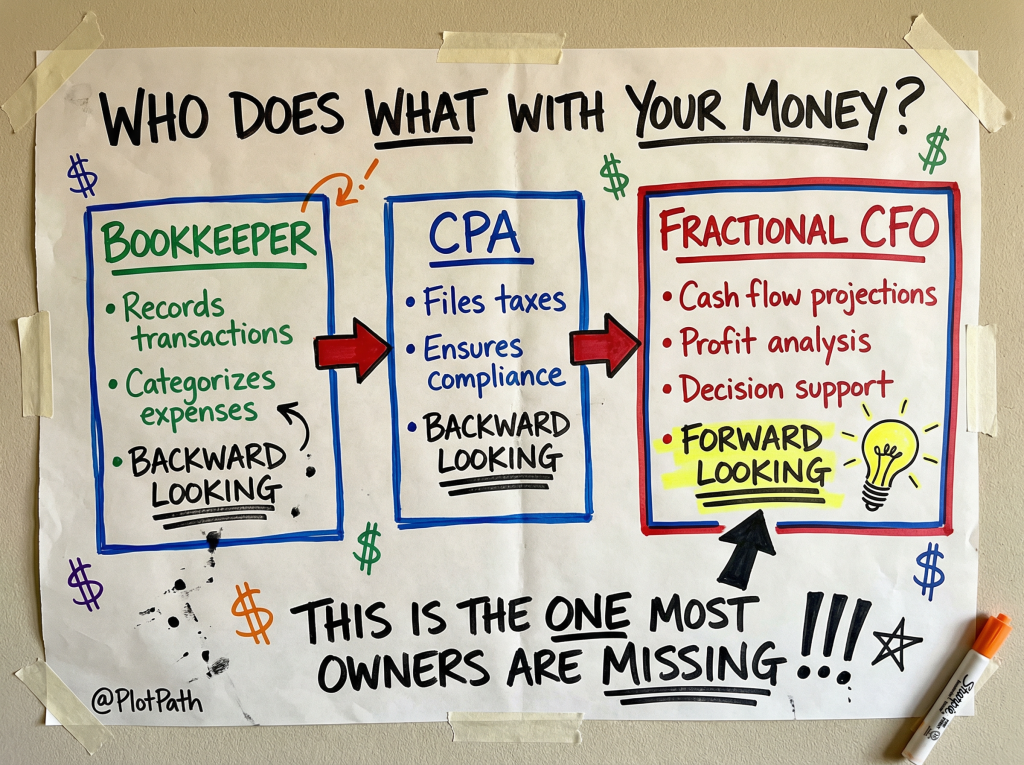
A fractional CFO provides part-time, outsourced chief financial officer services to businesses that need strategic financial leadership but don’t need (or can’t justify) a full-time hire. What does a fractional CFO do, specifically? They translate your financial data into decisions: cash flow projections, profit analysis, pricing strategy, hiring runway, and forward-looking plans that your bookkeeper and CPA were never designed to deliver.
Most business owners confuse having financial reports with having financial leadership. Reports tell you what happened. A fractional CFO tells you what it means and what to do next. When the role is filled well, owners stop guessing about cash, stop reacting to surprises, and start making decisions from a position of clarity. When the role stays empty, owners make million-dollar decisions on gut instinct, even when the data exists to guide them.
This guide covers what a fractional CFO actually does, how it differs from the roles you already have, and how to know if it’s the right move for your business.
Table of Contents
What “Fractional CFO” Really Means
The word “fractional” just means part-time. A fractional CFO is a senior financial professional who works with your business on a recurring but limited basis, typically a few hours per week or a set number of days per month.
They are not:
- A bookkeeper who also gives advice
- A CPA who dabbles in strategy
- A consultant who shows up once and disappears
They are a financial operator who embeds in your business, learns your numbers, and provides ongoing decision support. Think of it as renting the brain of a CFO without carrying the salary (which typically runs $200,000 to $400,000 per year for a full-time hire).
How It Works
A fractional CFO engagement typically follows a rhythm:
Month 1: Stabilization. They dig into your books, clean up what needs cleaning, and build a baseline picture of where the business actually stands. This often surfaces surprises. Revenue concentration risk, margins thinner than expected, cash conversion cycles that explain why money feels tight even when sales are strong.
Monthly cadence after that: They deliver owner-ready financial reporting (not just a P&L dump), review cash position and projections, flag risks and opportunities, and meet with you to translate the numbers into action. The meeting is usually 30 to 60 minutes. The prep work behind it is where the real value lives.
As-needed strategic work: Pricing changes, hiring decisions, expansion analysis, debt restructuring, investor preparation. These are the moments where a fractional CFO earns their fee many times over, because they can model the decision before you make it.
Why It Matters
Here is the gap most service business owners fall into:
Your bookkeeper records transactions. Your CPA ensures compliance. Neither one is designed to answer the questions that keep you up at night.
Questions like:
- Can I afford to hire two more people this quarter?
- Which service line is actually making money after overhead?
- If I lose my biggest client, how long is my runway?
- Should I take on debt to fund growth, or slow down?
These are CFO-level questions. Without someone in that role, you answer them with instinct. Sometimes instinct is right. Sometimes it costs you $200,000 in a bad hire or a year of growth you didn’t need to chase.
A fractional CFO exists to close this gap. Not with more reports, but with interpretation, context, and forward-looking analysis tied to your specific business.
Common Misconceptions
“It’s just outsourced accounting.” Accounting is backward-looking record keeping. A fractional CFO is forward-looking decision support. They use accounting data as an input, not a deliverable.
“My CPA already does this.” Most CPAs are tax-focused. They optimize your tax position, which is valuable. But they rarely provide ongoing cash flow management, scenario modeling, or strategic financial planning. Different role, different function.
“It’s only for big companies.” The fractional model exists specifically because small and mid-sized businesses need this work but can’t justify the cost of a full-time CFO. Businesses doing $1M to $10M in revenue are the sweet spot.
“I can just use dashboards and software.” Tools generate data. They don’t generate judgment. A dashboard can show your revenue trend. It can’t tell you whether that trend is sustainable, what’s driving it, or what happens to cash if it reverses. That requires a human who understands your business.
Financial Leadership Options Compared
| Approach | What You Get | What You Don’t Get | Best For |
|---|---|---|---|
| Bookkeeper only | Clean transaction records | Interpretation, strategy, forecasting | Businesses under $500K with simple operations |
| CPA only | Tax compliance, annual planning | Ongoing decision support, cash flow management | Businesses that need tax optimization above all |
| Full-time CFO | Dedicated strategic leadership | Cost efficiency (salary $200K-$400K+) | Businesses over $25M or with complex capital needs |
| Fractional CFO | Strategic leadership, ongoing cadence | Full-time availability | Service businesses $1M-$10M wanting clarity without overhead |
| DIY with software | Dashboards, reports, automation | Judgment, context, accountability | Owners who enjoy and are skilled at financial analysis |
FAQs
Q: How much does a fractional CFO cost? A: Most fractional CFO engagements range from $750 to $5,000 per month depending on scope, complexity, and the provider’s experience. This is a fraction of the $200,000+ annual salary a full-time CFO commands.
Q: How is a fractional CFO different from a financial advisor? A: A financial advisor typically manages personal investments or wealth. A fractional CFO operates inside your business, working with your P&L, cash flow, and operational data to drive business decisions.
Q: What size business needs a fractional CFO? A: Businesses generating roughly $1M to $10M in revenue tend to benefit most. Below that, the complexity may not justify the cost. Above that, a full-time CFO may make more sense.
Q: How often does a fractional CFO meet with me? A: Most engagements include monthly financial reviews, with availability for strategic questions in between. Some providers offer weekly cadences for businesses in transition or rapid growth.
Q: Can a fractional CFO replace my bookkeeper or CPA? A: No. The roles are complementary, not interchangeable. You still need clean books (bookkeeper) and tax compliance (CPA). A fractional CFO builds on top of both by adding interpretation and strategy.
Q: What should I look for when hiring a fractional CFO? A: Look for someone with operational experience in businesses similar to yours, a clear engagement structure, and a communication style that prioritizes plain language over jargon. The right fit translates numbers into decisions you can act on, not reports you file away.
Q: How quickly will I see results? A: Most owners report a shift in clarity within 30 to 60 days. The first major value often comes from surfacing a risk or opportunity that was hiding in the data. Structural financial improvements typically compound over 3 to 6 months.
When Financial Clarity Becomes a Priority
For business owners who have outgrown gut-feel decision-making but aren’t ready for a full-time CFO, fractional financial leadership fills a critical gap. It turns existing financial data into signals you can act on, delivered by someone whose job is to think about your business’s financial future. PlotPath is one example of this approach, providing CFO-level guidance as part of an integrated financial operating system for service businesses.


