
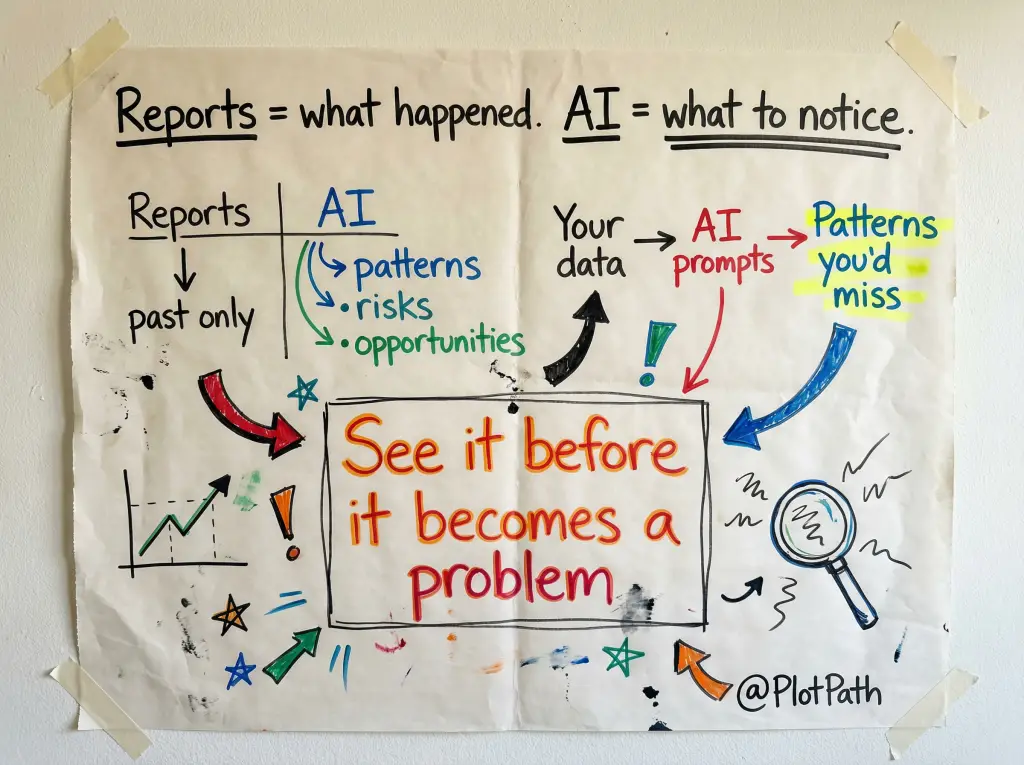
Most financial reports tell you what happened. They show revenue, expenses, and cash flow for a period that already ended. This is useful for compliance and record keeping. It is less useful for making decisions about what happens next.
The problem is not the reports themselves. It is that traditional financial reporting is designed to document the past, not predict the future. When you need to see patterns, risks, or opportunities before they become obvious, standard reports fall short.
AI changes this. When you feed financial data into AI tools with the right prompts, they can surface patterns humans miss. They can connect dots across time periods, identify anomalies before they become problems, and highlight opportunities buried in the numbers.
This article shows you how to use AI for financial pattern recognition. You will learn what AI financial analysis really means, why it matters, and how to use specific prompts that reveal insights your reports are not showing you.
What AI Financial Analysis Really Means
AI financial analysis is the process of using artificial intelligence tools to identify patterns, trends, and anomalies in your financial data that traditional reporting methods miss. It works by processing large amounts of numerical data quickly and finding relationships humans might overlook.
The key difference is perspective. Traditional reports answer \”What happened?\” AI analysis answers \”What is happening that I should notice?\” and \”What might happen next?\”
Here is how it works:
- Pattern recognition across multiple time periods and categories
- Anomaly detection that flags unusual changes before they become trends
- Correlation analysis that connects seemingly unrelated financial movements
- Predictive insights based on historical patterns and current trajectory
- Risk identification that surfaces potential problems early
This is not about replacing your bookkeeper or accountant. It is about amplifying their work by adding a layer of pattern recognition that helps you see your business differently.
Why This Matters
Most business owners review financial reports monthly or quarterly. By the time you see a problem in the numbers, it has already been happening for weeks or months. Revenue decline shows up in reports after clients have already churned. Cost creep appears after margins have already compressed.
The gap between when something starts happening and when it shows up in reports is where problems grow. AI analysis can narrow that gap by identifying early signals.
When done right, AI financial analysis helps you:
- Spot trends before they become obvious problems
- Identify opportunities hidden in the data
- Make decisions based on patterns, not just single data points
- Reduce the time between noticing a change and taking action
The alternative is waiting for problems to become large enough to show up in standard reports. By then, your options are more limited and more expensive.
How to Use AI for Financial Pattern Recognition: Step-by-Step
Step 1: Prepare Your Financial Data
Before you can analyze patterns, you need clean, organized data. Export your profit and loss statement and balance sheet for the last 12 months. Include monthly breakdowns, not just quarterly summaries.
Organize the data in a format AI can read. A simple spreadsheet works. Include:
- Month or period labels
- Revenue by category or service line
- Major expense categories
- Cash balance
- Accounts receivable and accounts payable if applicable
Do not include sensitive account numbers or personal information. Focus on the numbers that matter for business decisions.
Step 2: Choose Your AI Tool
You can use ChatGPT, Claude, or similar AI tools for financial analysis. The free versions work for basic analysis. Paid versions offer more detailed responses and can handle larger datasets.
The tool does not matter as much as the prompts you use. Focus on learning how to ask the right questions rather than finding the perfect tool.
Step 3: Use Pattern Recognition Prompts
Start with this prompt to identify overall patterns:
\”Here is my P&L and balance sheet for the last 12 months, broken down by month: [paste your data]
Based on this data, identify:
- Three patterns or trends that are not obvious from a quick review
- Any months that show unusual behavior compared to the overall trend
- Relationships between revenue changes and expense changes that might not be immediately apparent
Explain each pattern in plain business language, not accounting terms.\”
This prompt surfaces patterns you might miss. It asks AI to look for relationships and anomalies, not just summarize what happened.
Step 4: Use Risk Detection Prompts
Once you understand the patterns, use this prompt to identify risks:
\”Based on the financial patterns you identified, analyze the following:
- What are the three biggest risks to cash flow over the next 90 days?
- Which expense categories are growing faster than revenue, and what does that suggest?
- Are there any seasonal patterns or cycles that could create cash pressure?
For each risk, explain why it matters and what early warning signs to watch for.\”
This prompt helps you see problems before they become urgent. It connects current patterns to future risks.
Step 5: Use Opportunity Identification Prompts
Financial analysis should not only focus on problems. Use this prompt to find opportunities:
\”Looking at my financial data, identify:
- Which revenue streams or service lines show the strongest growth trends
- Where expenses have decreased or stabilized, creating margin improvement
- What the data suggests about where to invest or where to cut back
For each opportunity, explain what the data indicates and what actions might make sense.\”
This prompt helps you see where your business is performing well and where you might double down.
Step 6: Create a Monthly Review Rhythm
Pattern recognition works best when it is consistent. Set a monthly routine:
- Export your financials on the same day each month
- Run the same set of prompts
- Compare results month over month
- Track which patterns persist and which change
This creates a feedback loop. You start to see how patterns evolve, not just what they are at one moment.
AI Financial Analysis: Common Approaches Compared
| Approach | Pros | Cons | Best For |
|---|---|---|---|
| Manual Report Review | Familiar, no new tools needed | Slow, easy to miss patterns, focuses on past | Compliance and basic record keeping |
| Dashboard Tools | Visual, automated updates | Shows what happened, limited pattern recognition | Real-time monitoring of key metrics |
| AI Pattern Analysis | Fast pattern recognition, surfaces hidden insights | Requires clean data, needs interpretation | Finding trends and risks before they become obvious |
| Hybrid Approach | Combines human judgment with AI speed | Requires both tools and expertise | Business owners who want depth and speed |
The hybrid approach works best for most businesses. Use AI to surface patterns and risks quickly, then apply human judgment to decide what actions make sense for your specific situation.
Tips for Better Results
- Start with clean data. AI amplifies bad data just as easily as good data. If your books are messy, fix that first.
- Use consistent time periods. Comparing 11 months of data to 12 months creates confusion. Keep periods consistent.
- Ask specific questions. Vague prompts produce vague answers. The more specific your prompt, the more useful the analysis.
- Review patterns over time. One month of analysis shows a snapshot. Multiple months show trends.
- Combine AI insights with business context. AI sees numbers. You know your business. Use both.
- Focus on actionable insights. Patterns are interesting, but they only matter if they lead to decisions.
- Validate AI findings. If AI identifies a pattern that surprises you, dig deeper. Verify the data and understand why it appeared.
FAQs
Q: Can AI replace my bookkeeper or accountant?
A: No. AI is a pattern recognition tool, not a replacement for financial professionals. Use AI to surface insights, then work with your bookkeeper or accountant to understand what those insights mean for your business.
Q: How accurate is AI financial analysis?
A: Accuracy depends on the quality of your data and the specificity of your prompts. AI is excellent at finding patterns in numbers, but it cannot account for business context you have not provided. Always validate AI findings against what you know about your business.
Q: Do I need special software to use AI for financial analysis?
A: No. You can use ChatGPT, Claude, or similar tools with simple spreadsheet exports. The key is learning how to write effective prompts, not finding the perfect tool.
Q: How often should I run AI financial analysis?
A: Monthly works well for most businesses. This gives you enough data to see patterns while staying current enough to act on insights. More frequent analysis can create noise. Less frequent analysis misses opportunities to catch problems early.
Q: What if AI identifies a problem I did not know about?
A: This is exactly why AI analysis is valuable. When AI surfaces something unexpected, investigate it. Check the underlying data, understand why the pattern appeared, and decide what action makes sense. Do not ignore findings just because they are surprising.
Q: Can I use AI analysis for tax planning?
A: AI can identify patterns that might affect taxes, but tax planning requires professional expertise. Use AI to understand your financial patterns, then consult with a tax professional for specific tax strategies.
Q: What data should I include in my AI prompts?
A: Include your profit and loss statement and balance sheet for the last 12 months. Break it down by month. Include revenue categories, major expense categories, and cash position. Do not include sensitive account numbers or personal information.
Building a Financial System That Adapts
For business owners who need clarity without complexity, AI financial analysis provides a way to see patterns and risks before they become obvious problems. It works by processing financial data quickly and identifying relationships humans might miss.
PlotPath is one example of this approach. We combine clean monthly bookkeeping with AI-enhanced pattern recognition to help owners see their business clearly and make confident decisions.


