
How to build a simple, reliable forecast in under one hour using AI
Small business owners love the idea of forecasting. They imagine a clean chart, a confident number, and a plan they can trust. Then reality shows up. A delayed payment. A supply chain hiccup. A slow sales week. A key employee quits. Suddenly the forecast becomes useless.
Here is the hard truth: most small business forecasts fail because they are built like budgets instead of living models. Budgets are rigid. Forecasts must be adaptive. When owners treat them like the same thing, both collapse the moment the environment shifts.
This is why construction firms, HVAC companies, electricians, plumbers, roofing contractors, solar installers, agencies in marketing and advertising, staffing and recruiting shops, coaches, event production teams, tourism operators, software developers, IT firms, and MSPs all struggle with the same problem. They try to force a static view of the world on a dynamic business.
The Confusion: Budget vs Forecast
A budget is a target.
A forecast is a prediction.
Budgets are built once. Forecasts require revision as new information appears. Budgets track whether you are on or off plan. Forecasts help you see the future and adjust before the damage hits.
Most owners think they are forecasting when they are actually building a budget. They set a revenue goal. They guess expenses. They hope it works out. But the moment a curveball hits, the plan breaks. This creates false confidence and poor decisions.
If your revenue swings weekly, if labor availability shifts daily, if projects keep changing scope, or if your sales cycle is irregular, a budget alone will always fail you.
Forecasts exist to solve this problem.
Why Most Forecasts Break
Forecasts fail for three reasons.
1. They ignore real time data
Owners model the world based on last quarter, not last week. In industries like construction, HVAC, electrical, plumbing, roofing, or solar, one delayed job can wipe out three weeks of predictable cash flow. You need current numbers, not historical ones.
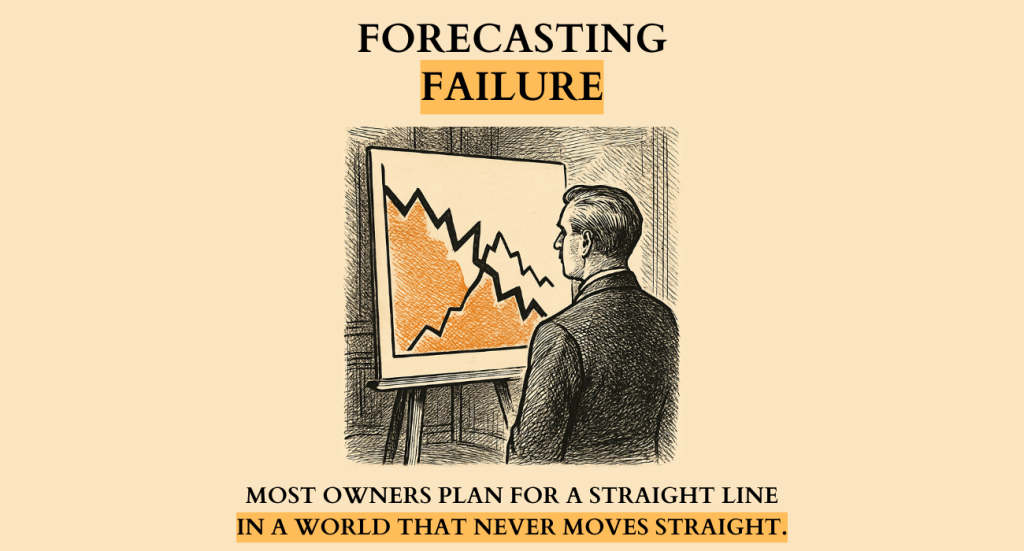
2. They assume a straight line
Marketing agencies, advertising firms, coaches, staffing companies, and recruiting agencies all have variable revenue patterns. Forecasting with a straight line growth assumption is fantasy. You need scenarios, not wishes.
3. They take too long to maintain
Software development shops, IT companies, and MSPs have complex cost structures. Most owners do not have time to rebuild a spreadsheet every week. So they stop maintaining the forecast. Once it is stale, it becomes useless.
AI solves this.
The New Way: AI Assisted Forecasting
AI\’s value is not that it builds the perfect model.
Its value is the speed.
You can get a functional forecast in under one hour. You can also revise it weekly in under ten minutes. That is the entire point. Forecasting only works when it is maintained. AI removes the friction.
Here is a simple workflow that works for any small business.
Step 1: Pull your last 90 days of data
You need only four things.
- Revenue by week
- Cash in and out
- Variable expenses
- Payroll
Export this from QuickBooks or your accounting tool. If you do job based work, pull job level revenue for construction, HVAC, electrical, plumbing, roofing, or solar jobs. If you run a marketing agency, advertising firm, staffing firm, recruiting firm, coaching practice, event production team, tourism operation, software company, IT agency, or MSP, pull client level revenue.
You do not need perfection. You need direction.
Step 2: Use AI to identify patterns
Paste your data into your AI tool and run this exact prompt:
AI Prompt: Pattern Finder
Analyze the revenue and expense patterns in this dataset.
Identify seasonality, irregular spikes, delayed payments, concentration risk,
labor swings, and any recurring cost patterns.
Highlight risks and opportunities over the next 12 weeks.
AI will surface what you already suspected but could not articulate: slow weeks, heavy payroll cycles, recurring invoice delays, seasonal shifts, and client dependencies.
Step 3: Build a rolling 12 week forecast
Paste the AI\’s findings back into your AI tool and run this:
AI Prompt: Rolling Forecast Model
Using the patterns identified above, create a rolling 12 week forecast
for revenue, expenses, cash flow, and profit.
Provide three scenarios: conservative, expected, and optimistic.
Build this in a simple table format and include the projected cash balance each week.
This turns your historical data into a forward view that adjusts weekly.
Step 4: Add your upcoming pipeline
This is where most forecasts fall apart. They ignore the pipeline. Your pipeline determines your future reality.
Run this prompt:
AI Prompt: Pipeline Integration
Here is my current pipeline of jobs or clients.
For each, assign a probability, expected close date, and expected revenue.
Integrate this pipeline into my 12 week forecast and show how each probability
affects the projected cash balance.
Suddenly you have a forecast that reacts to sales and job activity, not random wishful thinking.
Step 5: Stress test the model
Forecasting is not prediction. It is preparation.
Run this:
AI Prompt: Stress Test
Apply stress test scenarios to the forecast.
Show the impact if labor costs increase 10 percent,
if revenue drops 20 percent for three weeks,
if two invoices pay late, or if a key job gets delayed.
Provide recommendations for each case.
This forces clarity. You can now see your business in motion.
Step 6: Revise weekly
This is where most owners drop the ball. Forecasts die without maintenance. You do not need to rebuild anything. Just feed AI your updated numbers every Friday.
Run this:
AI Prompt: Weekly Update
Here are my updated weekly numbers.
Update my rolling forecast, recalculate the scenarios,
and highlight any new risks or opportunities.
Ten minutes. That is it.
What You Gain
Owners in construction, HVAC, electrical, plumbing, roofing, and solar gain control over cash cycles.
Agencies in marketing, advertising, staffing, recruiting, coaching, event production, and tourism gain visibility into variable revenue.
Software companies, IT firms, and MSPs gain clarity on labor cost structure and client concentration.
You also gain something more important. A calm mind. Forecasting stops the guesswork. AI removes the friction. Together they give you a simple, stable financial rhythm.
Most owners think forecasting requires complexity. It does not. It requires consistency.
And now you have a way to maintain it without adding pressure to your workload.


