
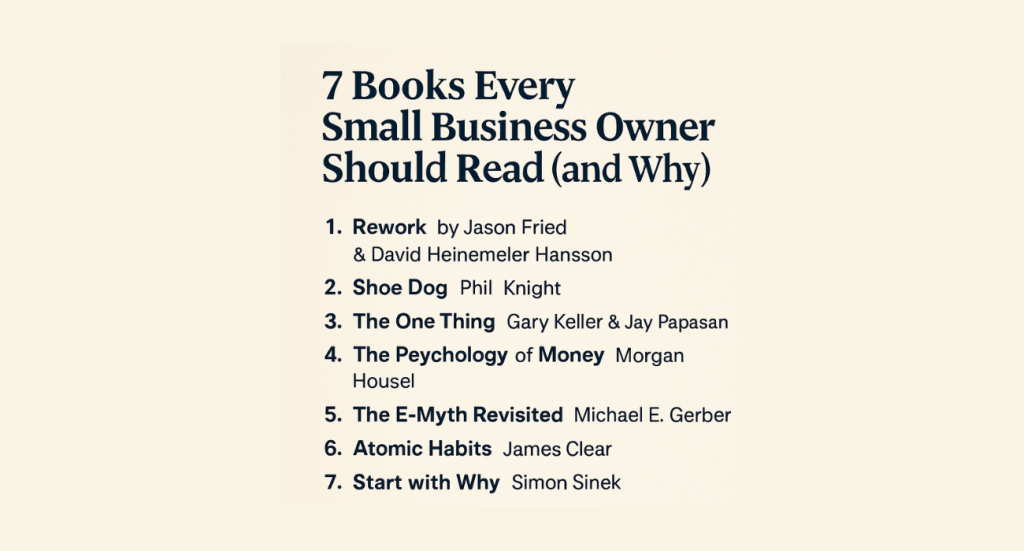
Running a business is one long experiment in decision-making. Some days you’re leading a team; others, you’re the bookkeeper, marketer, and therapist all in one. The right book at the right time can shift how you think, help you fix what’s broken, and remind you why you started in the first place.
The books below aren’t “corporate strategy” textbooks. They’re the ones that shape how small business owners actually build, how they manage cash, design systems, and lead from clarity instead of chaos.
Here are seven that every entrepreneur, owner, and operator should keep within reach.
1. Rework: Jason Fried & David Heinemeier Hansson
Summary: Rework challenges almost every assumption about how business should be run. The founders of Basecamp argue that meetings kill progress, plans are guesses, and growth for growth’s sake is overrated. Their minimalist approach to work strips away the noise so you can focus on what matters — creating value and staying profitable.
Why it matters: Small business owners rarely have extra time or people. This book shows how to simplify operations, communicate better, and keep control of your business instead of drowning in it.
- Build less, finish more — progress beats perfection.
- Ignore “best practices” if they don’t fit your business.
- Profit is oxygen — growth is optional.
“Workaholics aren’t heroes. They don’t save the day, they just use it up.”
2. Shoe Dog: Phil Knight
Summary: This is Nike founder Phil Knight’s memoir — the gritty, vulnerable story of how one man built a brand from selling shoes out of his trunk into one of the world’s biggest companies. It’s not a how-to manual; it’s a story about grit, fear, and faith in a vision no one else could see.
Why it matters: Entrepreneurship isn’t clean or linear. Shoe Dog captures the real rhythm of business — cash crunches, tough hires, moments of doubt — and shows that belief and persistence are sometimes the only fuel that gets you through.
- Start before you’re ready — clarity comes from movement.
- Bet on relationships, not just ideas.
- Fear can be a compass — follow what scares you.
“Life is growth. You grow or you die.”
3. The One Thing: Gary Keller & Jay Papasan
Summary: This book distills productivity down to one essential question: “What’s the ONE thing I can do such that by doing it everything else will be easier or unnecessary?” It’s a framework for focus — not on doing more, but on doing what matters most.
Why it matters: Business owners are pulled in 100 directions. The One Thing teaches you to identify the few actions that actually drive growth and to build systems around them.
- Focus isn’t saying yes — it’s saying no to everything else.
- Multitasking is a lie; sequential progress wins.
- Small, consistent effort compounds into massive results.
“Success is about doing the right thing, not about doing everything right.”
4. The Psychology of Money: Morgan Housel
Summary: Morgan Housel explores how money decisions are rarely rational — they’re emotional, shaped by experience and personality. Through stories and research, he explains why good financial behavior is more about temperament than intelligence.
Why it matters: Every small business owner’s decisions — from pricing to reinvestment — are ultimately money decisions. This book helps you see your own biases and adopt a calm, long-term mindset around wealth.
- Wealth is what you don’t see — savings, not spending.
- Compounding works only if you stay in the game.
- Financial success is a soft skill: patience, humility, restraint.
“Doing well with money has little to do with how smart you are and a lot to do with how you behave.”
5. The E-Myth Revisited: Michael E. Gerber
Summary: Gerber reveals why most small businesses fail: the owner gets trapped doing technical work instead of building systems. He shows how to build a business that runs on process, not personality.
Why it matters: This is essential reading for anyone who feels like their business owns them. It’s the playbook for turning chaos into consistency and burnout into freedom.
- Work on your business, not just in it.
- Document everything — systems create freedom.
- Your business is a prototype, not a prison.
“If your business depends on you, you don’t own a business—you have a job.”
6. Atomic Habits: James Clear
Summary: James Clear breaks success down into systems of small, repeatable habits. He shows how identity-based habits — not goals — create lasting transformation, both personally and professionally.
Why it matters: Growth in business mirrors growth in self. Atomic Habits gives owners a structure for daily improvement — the compound interest of behavior.
- Small changes, big results — 1% better daily compounds fast.
- Design your environment to support your habits.
- Identity drives behavior — become the type of person who does the thing.
“You do not rise to the level of your goals. You fall to the level of your systems.”
7. Start with Why: Simon Sinek
Summary: Simon Sinek explores why some leaders inspire loyalty and others don’t. His “Golden Circle” framework — Why, How, What — starts with purpose and cascades into clear communication and culture.
Why it matters: When owners reconnect to their “why,” every message, hire, and decision gains alignment. It’s how small businesses attract the right people and retain customers who believe in the mission.
- People don’t buy what you do — they buy why you do it.
- Purpose fuels resilience when strategy fails.
- Great brands are built from the inside out.
“Working hard for something we don’t care about is called stress; working hard for something we love is called passion.”
Final Thought
Books are the cheapest mentorship you’ll ever get. The right ones give you perspective, pattern recognition, and calm. If you read these seven with intention, not as entertainment, but as blueprints you’ll start to see your business differently: clearer, simpler, and more under control.


