
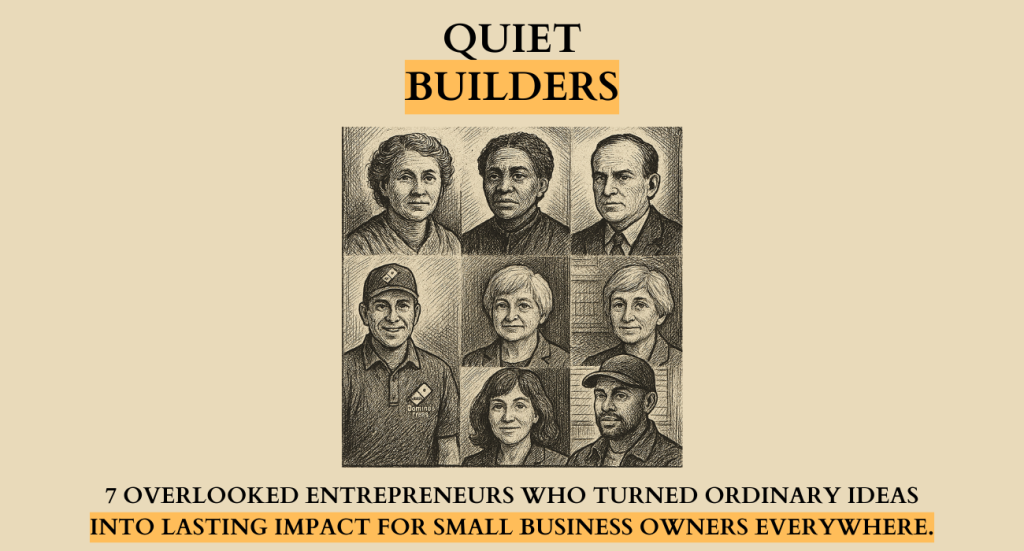
1) Joy Mangano: The Relentless Inventor of Iteration
Joy created the Miracle Mop and then kept going with dozens of household products. Her advantage was not a single big idea. It was the speed of her feedback loop. She prototyped, demoed in person, watched reactions, and changed the product the same week. She chased customer truth, not investor validation.
“My famous line is ‘Product is king.’”
Joy Mangano
Why it matters for owners: Most shops fail from weak feedback, not weak ideas. Let your market write the roadmap. Build, show, learn, adjust, repeat.
AI Prompt to use now:
Act as a customer insight analyst. I run a [type of business]. Generate 10 specific customer frustrations you hear at the counter, on calls, or in support tickets that could inspire a new product, service upgrade, or process fix. Rank by urgency and emotional intensity, and propose the smallest possible test for the top 3.
2) Biddy Mason: The Ownership Operator
Born enslaved in 1818, Biddy Mason secured her freedom, worked as a nurse and midwife in Los Angeles, bought small lots, and compounded her way into meaningful wealth. No hype. Just steady ownership in a growing market, plus constant reinvestment in her community.
“If you hold your hand closed, nothing good can come in. The open hand is blessed, for it gives in abundance, even as it receives.”
Biddy Mason
Why it matters for owners: Own something that compounds. That can be your building, your data, or your customer list. Renting everything keeps you fragile.
AI Prompt to use now:
I run a [local business] in [city]. Compare a 10 year path where I keep leasing versus a path where I buy a modest commercial condo in year 2. Show after tax cash flow, likely equity, and control tradeoffs. Include a short checklist to start underwriting one realistic property this quarter.
3) Tom Monaghan: The Systemizer
Tom bought a failing pizza shop for under a thousand dollars and turned it into Domino’s by simplifying. Fewer SKUs. Faster prep. A promise that disciplined the entire operation. He scaled consistency, not complexity.
“My most visible accomplishment in life has been building Domino’s Pizza from a single store into the world’s largest pizza delivery company.”
Tom Monaghan
Why it matters for owners: Growth by subtraction is real. Every extra offer increases training time, errors, and inventory waste unless it fits the core system.
AI Prompt to use now:
I operate a [service or retail business]. List my current offers and identify which 20 percent create 80 percent of margin and on-time delivery. Recommend which offers to cut or bundle, and propose a simple SOP and 3 KPIs to keep the remaining offers fast and consistent.
4) Anita Roddick: The Values as Moat Builder
Anita started The Body Shop in a tiny space, reused bottles, sourced ethically, and made operations match her values. That clarity built trust before she spent on broad advertising.
“The business of business should not just be about money, it should be about responsibility. It should be about public good, not private greed.”
Anita Roddick
Why it matters for owners: Customers buy alignment. When your values change how you operate, you create signal that marketing alone cannot fake.
AI Prompt to use now:
I run a [type of business]. Identify 3 values my team already lives today. For each, give one visible operating practice I can implement this month, one proof point to show customers, and one way to measure trust lift in retention or reviews.
5) Tristan Walker: The Community Connector
Tristan built Bevel by serving people the industry ignored. He reframed the market: if a segment looks small, maybe it is underserved, not unprofitable. Depth over breadth created loyalty and growth.
“Perhaps the market is so small because you do not have products that serve the needs of the community.”
Tristan Walker
Why it matters for owners: The niche is often the market. When you serve a specific group deeply, price pressure drops and referrals rise.
AI Prompt to use now:
I provide [product or service]. Identify one underserved segment in my market with clear pain and spending power. Draft 3 offer variations, 3 message angles, and 3 places to reach them within 14 days. Include one low cost validation test for each offer.
6) Janet Yellen: The Disciplined Decision Maker
Before leading the Fed and Treasury, Yellen ran a small economics consultancy. Her edge was structured thinking. Build a simple model, define the indicators, and explain decisions clearly to maintain credibility.
“In government institutions and in teaching, you need to inspire confidence. To achieve credibility, you have to very clearly explain what you are doing and why.”
Janet Yellen
Why it matters for owners: You do not need a complex dashboard. You need a short list of leading indicators and the discipline to act when they move.
AI Prompt to use now:
I own a [type of business]. Recommend 5 leading indicators to track weekly that warn me before cash gets tight. For each, define a simple threshold and the first corrective action to take when the number crosses that line.
7) Daymond John: The Street Level Validator
Before TV, Daymond stitched hats at home and sold them face to face. He learned fast because money is the cleanest feedback. Real buyers will tell you the truth with their wallets.
“Sales cure all.”
Daymond John
Why it matters for owners: Stop guessing. Run small paid tests. When people pay, you learn what to keep, what to cut, and what to improve.
AI Prompt to use now:
Act as a street level coach. I want to validate a new [offer]. Build a 7 day plan that forces real sales: a one page offer, a price test, a tiny list of 25 prospects, 3 outreach scripts, one pop up or booth idea if relevant, and a simple sheet to track attempts, replies, and revenue.


